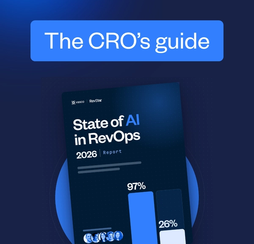
AI adoption is moving quickly through revenue teams. The harder question is what happens when those systems start producing numbers that people are expected to defend.
An agent can tell a CRO that the quarter is on track, produce a polished chart, and still leave a basic question unanswered: which definition of pipeline did it use?
That gap matters for RevOps leaders. It affects which AI investments are worth making, where human review is still necessary, and how much confidence the organization can place in an AI-generated number.
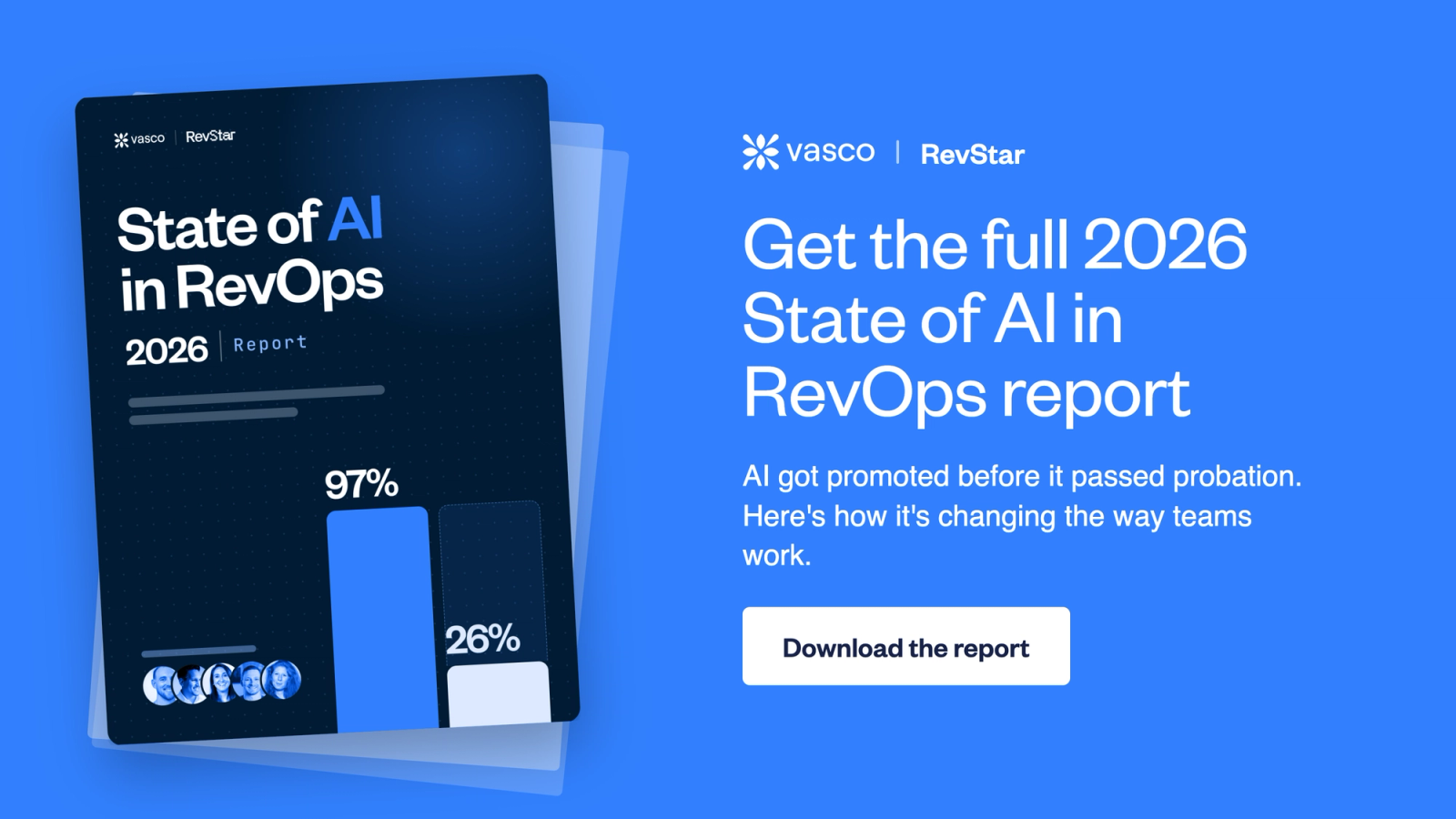
We asked the RevStar community and beyond how they use AI, how far they trust it, what they distrust in their data, how long they spend checking it, and who answers when an AI-generated number is wrong. We then took those findings to seven operators who build and govern AI in revenue teams.
The first four Parts of the report are covered below. Parts 5 and 6, which examine who owns the context behind AI and what teams can do when that context is reliable, are in the full report.
With insights from:
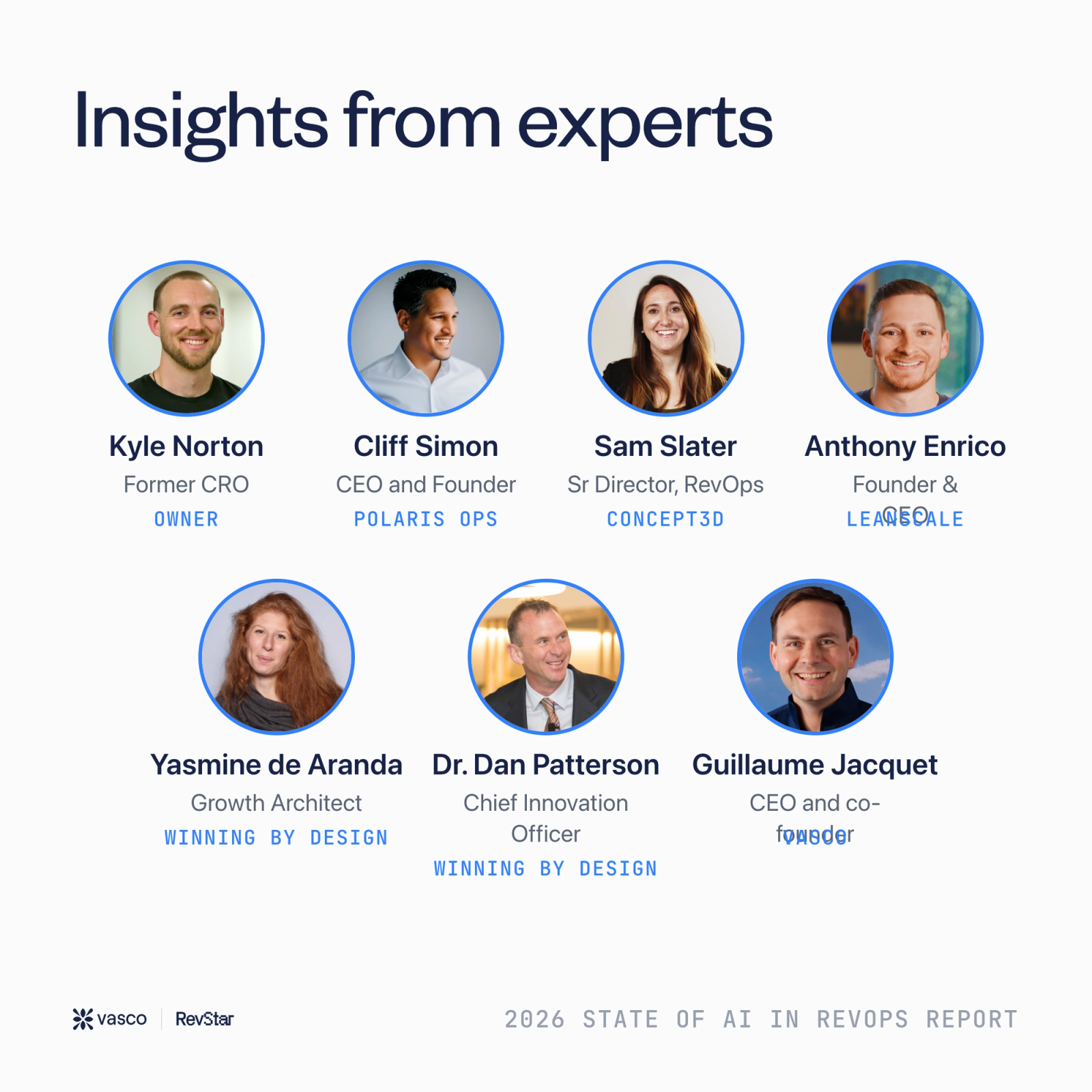
- Kyle Norton, Chief Revenue Officer @ Owner.com | Follow Kyle on LinkedIn
- Cliff Simon, Founder & CEO @ Polaris Ops | Follow Cliff on LinkedIn
- Sam Slater, Senior Director, Revenue Operations @ Concept3D | Follow Sam on LinkedIn
- Anthony Enrico, Co-Founder & CEO @ LeanScale | Follow Anthony on LinkedIn
- Yasmine de Aranda, Revenue Architect @ Winning by Design | Follow Yasmine on LinkedIn
- Dr. Dan Patterson, Chief Innovation Officer @ Winning by Design | Follow Dan on LinkedIn
- Guillaume Jacquet, CEO @ Vasco | Follow Guillaume on LinkedIn
What the report covers
The research starts with a simple question:
What happens when AI takes on more responsibility before the organisation fully trusts the systems underneath it?
The answer develops across six Parts:
- AI adoption has outpaced trust. How widely revenue teams are using AI, and how that compares with their confidence in its output.
- The data behind the answer. Why disagreements over definitions and sources of truth create more distrust than basic data hygiene.
- AI meets real revenue work. Where teams are seeing value today, and where use cases are stalling or being rolled back.
- The work AI doesn’t remove. How much time teams still spend validating AI output, and why that work often disappears from productivity calculations.
- RevOps and the question of ownership. Who owns the definitions, decisions, and accountability that AI depends on. In the full report.
- What reliable context enables. What revenue teams can hand to agents once the underlying context is consistent and traceable. In the full report.
Part 1: AI adoption has outpaced trust
Adoption moved faster than confidence
AI is now part of revenue work for almost every team in the survey. More than a third describe it as broadly deployed or mission-critical.
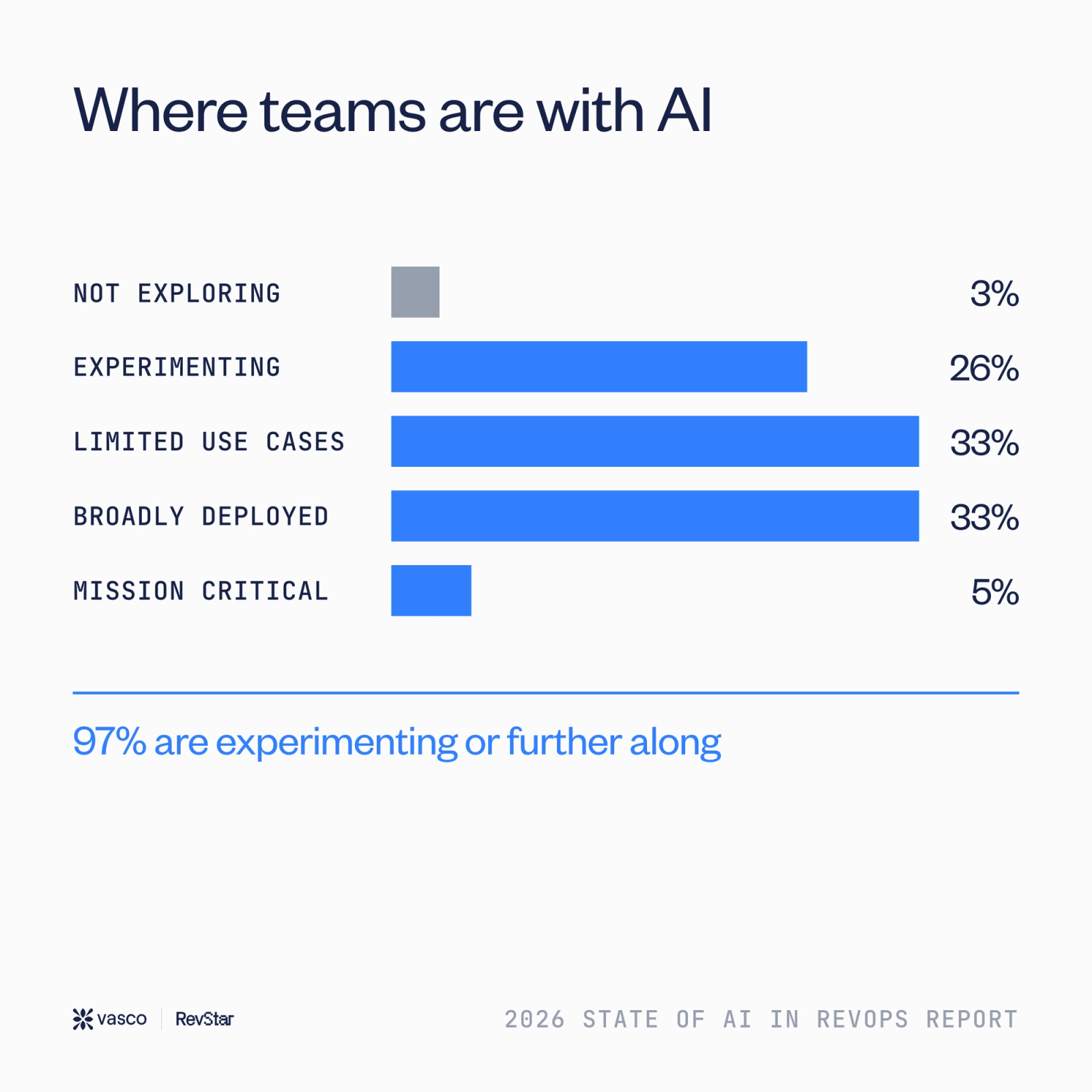
Confidence has not kept pace.
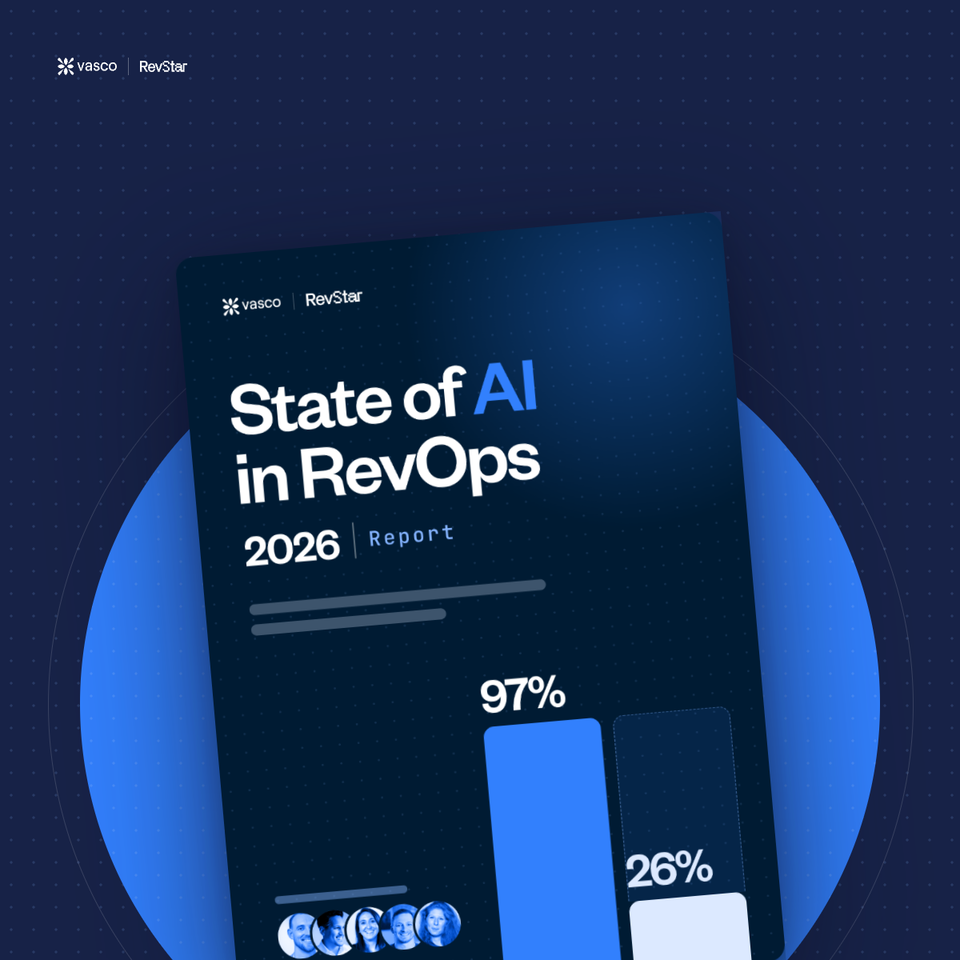
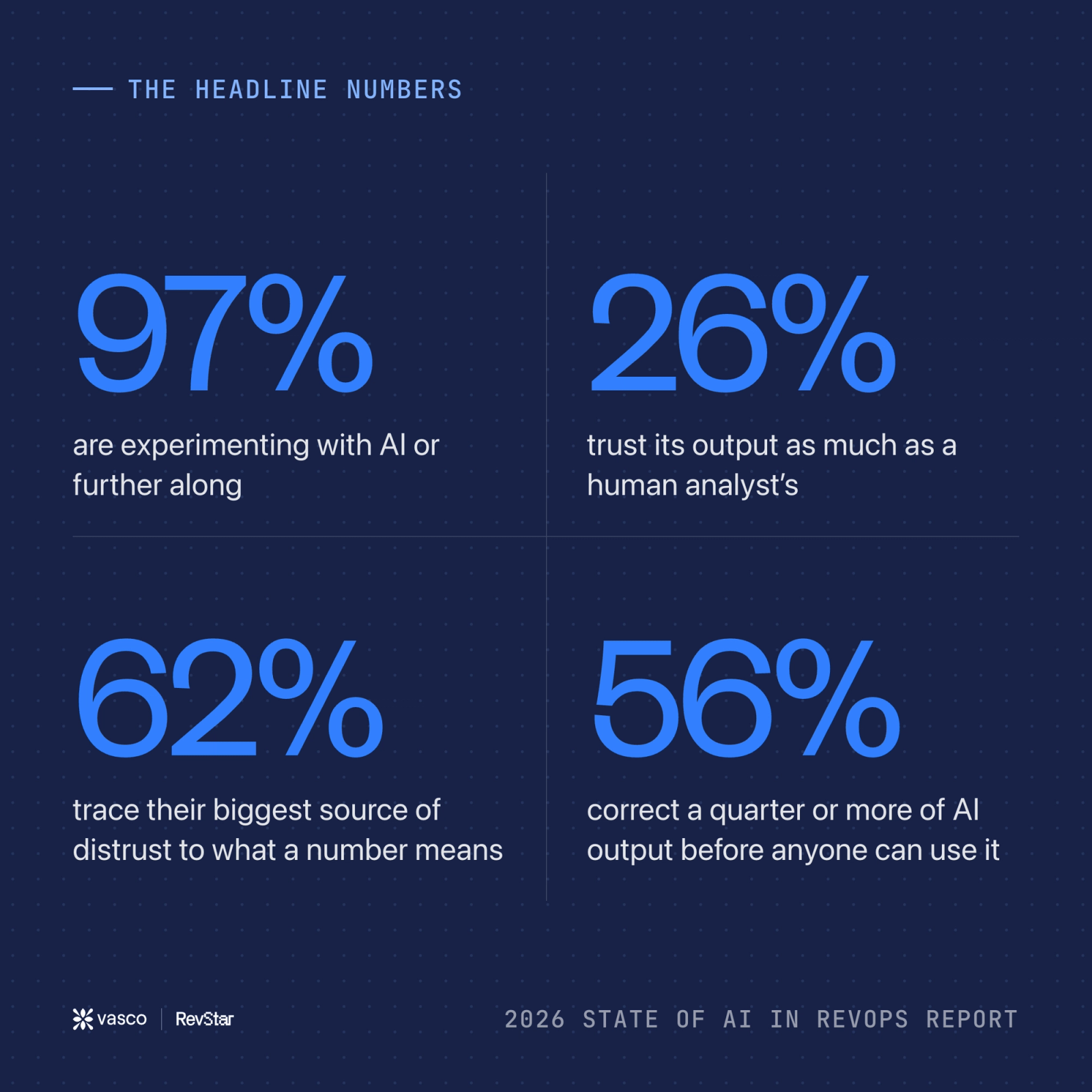
Only 26% of respondents say they trust AI output as much as they trust an analyst's work. No respondent gave AI a 5 out of 5 for trust.
The relationship between adoption and trust is weak. Among the 15 teams that describe AI as broadly deployed or mission-critical, only three trust its output at the same level as an analyst's.
That distinction matters. Adoption tells us that teams are using AI. It does not tell us whether they are prepared to rely on it.

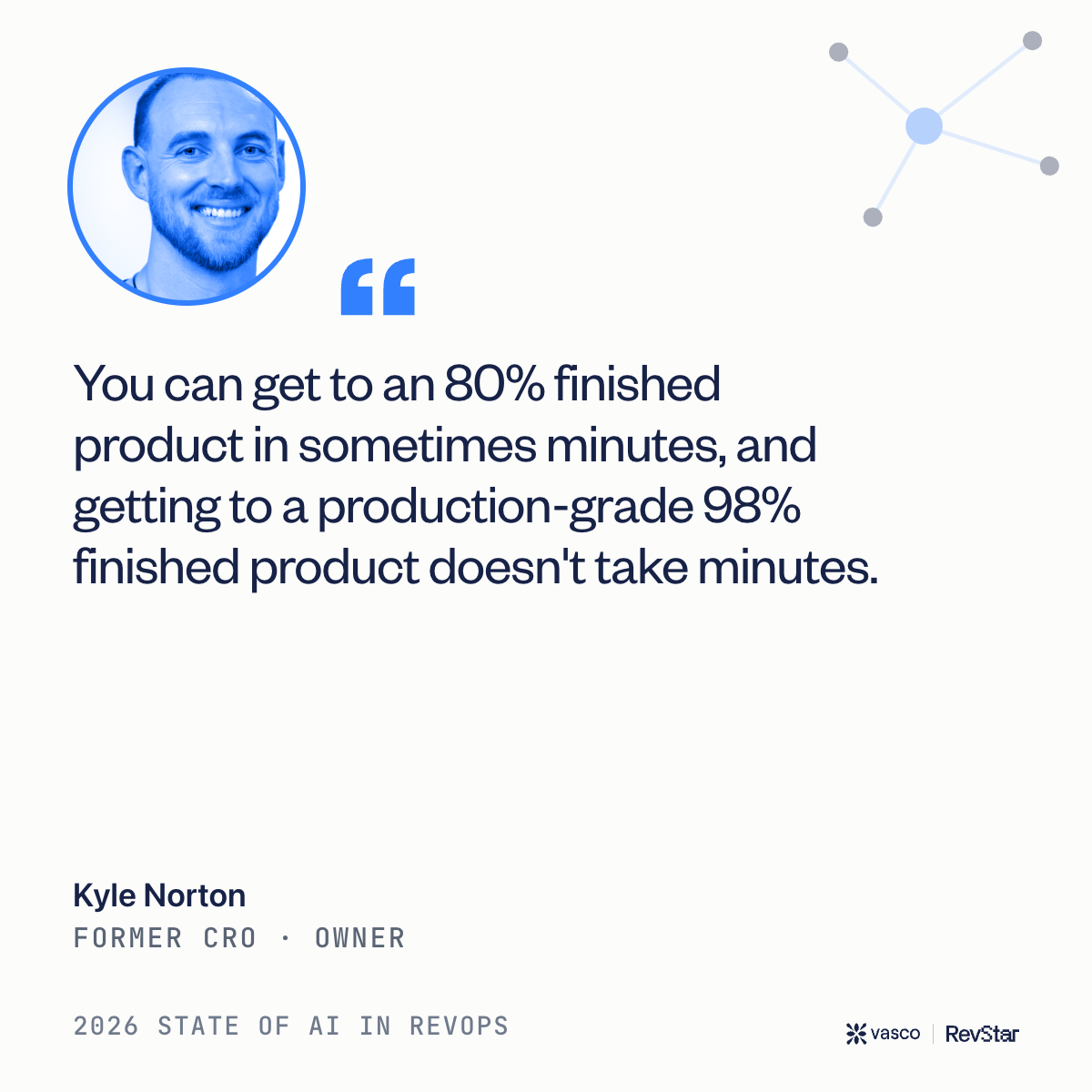
Kyle Norton, former CRO at Owner, describes the dynamic as chasing "the sugar rush in GTM AI."
A first version of an agent can arrive quickly and feel like progress. Turning that agent prototype into something a revenue organization can rely on is a different exercise.
The trustworthy version, Kyle says, "takes hours and days and testing and evals and feedback loops and starting all over."The less visible work is often the work that determines whether the system holds up.
"The data work is hard and it's not very rewarding," he said. But without sound data foundations, "basically nothing else works."
What this means for RevOps: adoption and trust should be tracked separately. A workflow can be widely used and still require human review before anyone allows it to act.
Operator tip from the report: Track three stages for every AI workflow: that it was used, trusted, and allowed to act.
What to explore in the full report
- Why 8 of the 15 most advanced teams still say their CRM is not clean enough for an agent to act on without review
- A question to ask about every AI workflow your team uses but would not yet allow to operate independently
The board number gets more scrutiny than the AI number
There is a notable gap between the numbers revenue leaders are willing to take to the board and the numbers they are willing to let AI act on.
Sixty-seven percent of respondents have high trust in the numbers they take to the board. Only 26% say the same of AI output.
The difference is partly procedural
Board numbers are reconciled, challenged, reviewed, and signed off before they reach the meeting. That verification process does not automatically transfer to an AI system.
Among the 26 respondents who said they have high trust in their board figures, 16 still said their CRM was not ready for an agent to act on without review.
The human-generated number is not necessarily reliable either. Fifty-six percent of respondents have discovered that a number was wrong after it had already been presented or acted on. For 21%, this happens frequently or constantly. Another 44% worry that the next number they present could turn out to be wrong.

One founder in the survey described the problem this way:
"We had a quarter where the forecast looked solid right up until it wasn't."
The subsequent review found that some strategic plays were not happening consistently and CRM updates were incomplete. Senior leadership eventually went account by account, comparing what had been reported with what had actually happened with customers.
The important distinction is between visibility and verification
A system can make a number easy to see without making it reliable. The process that validates a number is often separate from the process that produces it. An AI system typically inherits the latter.

What to explore in the full report
- Kyle Norton on why models designed to provide useful answers still need permission to say "I don't know"
- Dr. Dan Patterson on the relationship between forecast mathematics and the quality of its inputs
- Where to start when a forecast is challenged
Part 2: The data behind the answer
One CRM can produce four different answers
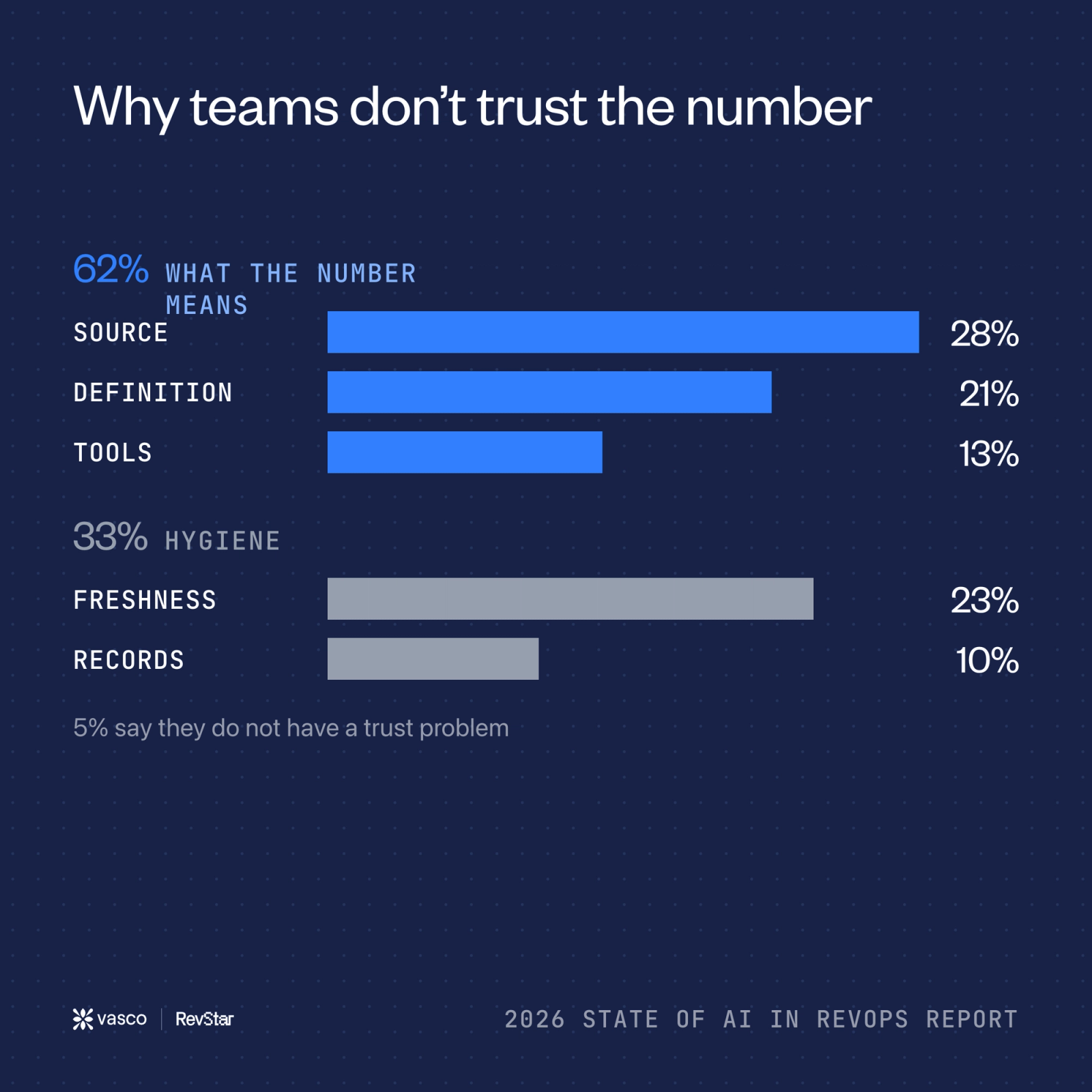
When respondents were asked what creates the greatest distrust in their numbers, 62% pointed to a missing source of truth, inconsistent definitions, or systems that disagree.
Thirty-three percent pointed to data hygiene issues such as stale or duplicate records.
Both matter. The distinction is that cleaning the CRM does not necessarily resolve a disagreement about what the number means.
One respondent described RevOps and Marketing repeatedly calculating pipeline differently, reaching agreement, and then revisiting the definition the following year.
Add Finance's weighting and the CEO's board-deck definition, and the same underlying records can produce four different answers.

This is where the distinction between data quality and data meaning becomes important.
A clean CRM gives an AI system cleaner facts. It does not tell the system which facts matter, which definition to apply, or how the organisation relates one measure to another.
An agent inherits your data’s ambiguity
Guillaume Jacquet, Vasco's CEO, gives a simple example. Ask an agent with raw access to every system for an account's "pain point," and it may identify a support ticket about a password reset.
That is technically a customer problem. It may not be the problem that drove the buying decision.
Without the definition of "pain point" and the customer journey surrounding it, the agent has to infer what the business means. The answer can be factually grounded and still be wrong for the question.
Traceability creates another layer of trust
Sam Slater points out that people have been trained to expect an explanation from AI because they encounter it through chat. That expectation carries into revenue work.
"If I'm like, that number is 27. They're like, cool, I want to see the report."
A number that cannot be traced to its sources, definitions, and underlying records is difficult to validate. In practice, that makes it difficult to use.
The report calls the required structure a metric passport:
- Source. Where did it come from, and which system is authoritative?
- Definition. What exactly does it mean? Which stages, filters, and dates count?
- Context. What happened around it? Which plans, targets, and history apply?
- Relationships. Which account, opportunity, or customer does it belong to across systems?
- Traceability. Can someone see how the agent reached the answer?

What to explore in the full report
- Why an agent may have to reverse-engineer your definition of MQL every time it answers a question
- Anthony Enrico on the assumptions agents make when nobody has documented which stages count
- Kyle Norton on why disagreement between datasets creates operational problems
Governance starts before the agent
The research points to a conclusion that is easy to miss in the rush to deploy agents: governance begins before the agent exists.
When we asked the experts where to start, they consistently moved the conversation upstream.
An agent can only be as aligned as you’ve instructed it to be
Those decisions flow from company strategy to departmental objectives, functional metrics, definitions, data, and eventually the fields an agent reads.
Yasmine de Aranda of Winning by Design says leadership should establish leading indicators "at a company level, and then granularly at a department level, and then at a functional level."
When each team defines success independently, she says, "everybody's after their own numbers and their own vanity metric."

Anthony Enrico, whose team at LeanScale builds agents for clients, puts the split at 90/10.
"I can spin up an agent in ten minutes," he said. "I can build a very, very good forecasting agent and workflow, if I have the data model."
The implication is less about the precise ratio than the sequence. Building the workflow is often easier than establishing the model it depends on.
"It's like you have an F1 car with the fastest engine in the world, but you have no map of where you want to go."

What to explore in the full report
- Dr. Dan Patterson on why sales, marketing, and finance can track valid metrics that do not match
- How to divide a quarterly target across new business, retention, and expansion
- Cliff Simon on what happens when a new field gets added every time a sales leader needs a different answer
The stakes change when AI stops answering and starts acting
There is an important distinction between asking AI for an answer and giving it permission to take action.
Sixty-seven percent of respondents rate their CRM 1 or 2 out of 5 for being clean enough for an agent to act on without review. Only 18% rate it 4 or 5.
That caution becomes easier to understand when looking at how small data distinctions can change an action.
Sam Slater's team at Concept3D found that its next-best-action agent repeatedly told one BDR to call the same account. The contact was marked "Gatekeeper" when the underlying issue was actually a bad phone number.
The agent was following the available data. The data contained the wrong distinction.

There is a quieter version of the same problem.
Reps sometimes put next steps in an opportunity description rather than the designated next-step field. An agent reading the structured field can then recommend pursuing an opportunity that already has a meeting scheduled.
The issue is not that the agent cannot follow instructions. It is that the organisation has not given it enough reliable context to distinguish the situations that matter.
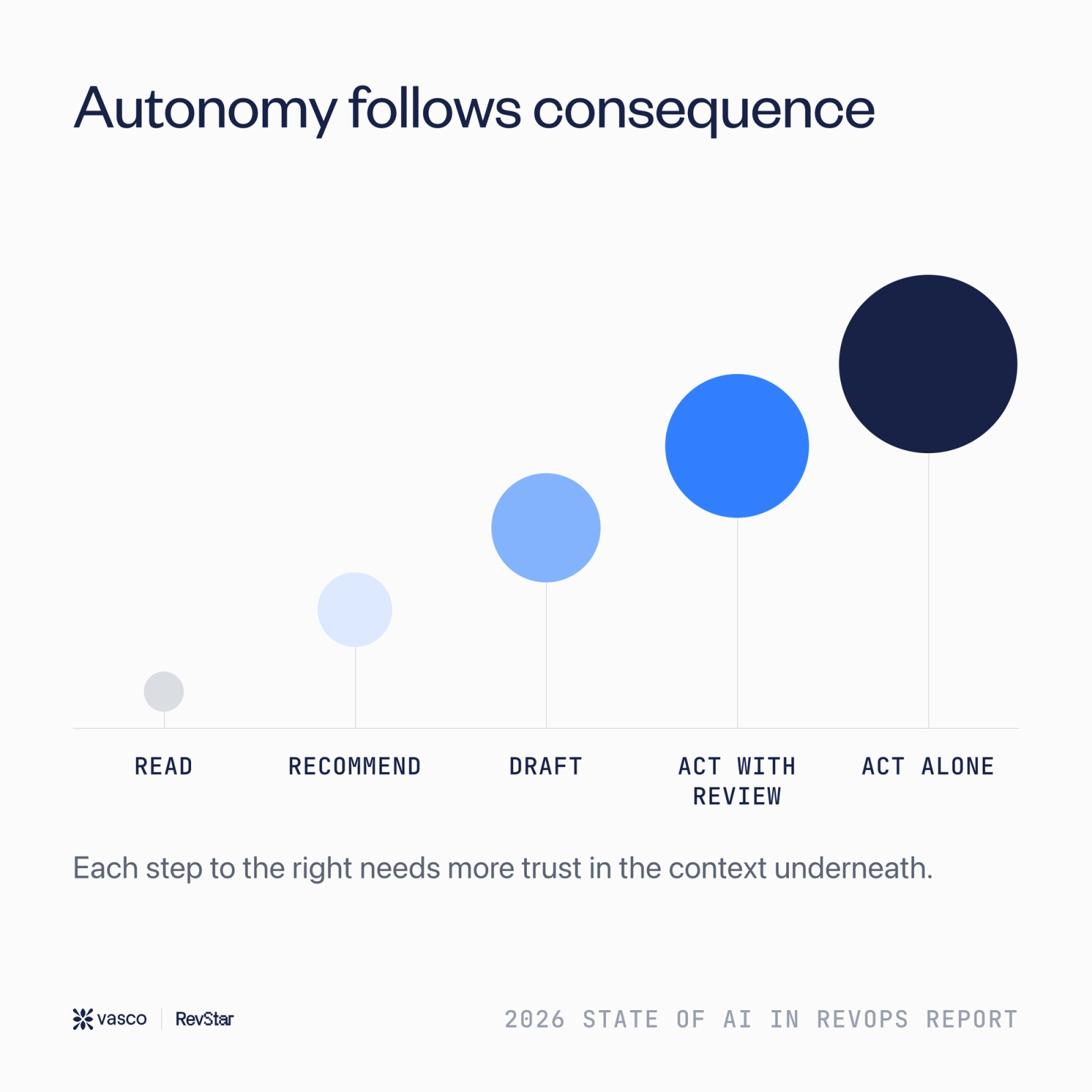
Sam matches autonomy to consequence
"I'm much more willing to let it rip on a BDR calling somebody the wrong person. A lot more than I am around revenue data."
That principle underpins the report's autonomy ladder. As the consequence of an incorrect action increases, the requirements for reliable context and human review increase with it.
What to explore in the full report
- Cliff Simon's "super-intelligent six-year-old" analogy, and what a dishwasher reveals about the importance of definitions
- A low-risk action teams can consider handing to an agent next month
See how your team compares
Answer the survey's core questions and receive a personalised benchmark, plus one practical action to consider at each stage.
Part 3: AI meets real revenue work
AI performs best where the definition is firm
The research does not point to a simple divide between AI use cases that work and those that do not. Instead, the pattern changes with the nature of the work.
Account and lead research was the most frequently cited area of value, at 56%, followed by reporting and board decks at 44%.
Both are relatively bounded tasks. The output can be reviewed by a person before it informs a decision.
Related reading
- Why not just connect Claude to HubSpot? If another connector seems like the obvious answer, start here.
- Context graphs for GTM teams How definitions and relationships can be made available to agents.
- A forecast accuracy guide for CROs: A deeper look at the governance behind revenue numbers.
The pattern changes closer to consequential revenue decisions
Forecasting and CRM hygiene were each named by only 10% of respondents as areas where AI delivers value. They were also among the use cases most frequently reported as stalled or rolled back in the previous year, at 31% and 36%, respectively.
Two-thirds of respondents have seen at least one AI use case stall.
The finding points to a broader relationship: as AI moves closer to a consequential revenue decision, the cost of ambiguity rises.

Sam Slater sees the distinction in renewal work.
"At renewal, there's a right answer."
Earlier in the funnel, the answer becomes less deterministic. Sometimes the appropriate next action is to do nothing, even when an account appears highly engaged.
"The definitions are a lot wigglier over there," Sam said.
Her team's renewal agent operates in a more constrained environment. It reads last year's renewal, checks the contracted uplift, reviews recent customer conversations, and proposes a renewal number.
The result was a reduction from 50% of renewals requiring AM intervention to 15%
A contract provides a clear reference point for the number. The agent is operating inside a defined business process rather than trying to infer one.
The examples point to a useful distinction for AI planning: the question is not simply whether a workflow can be automated. It is how much organizational context the workflow requires before automation becomes reliable.
Guillaume Jacquet groups agent work into four categories based partly on the amount of shared business context each requires.
"There is always a gap between the strategy and the execution," he said. "And agents are just amazing at finding those gaps."

A framework from Guillaume Jacquet, CEO and co-founder, Vasco.
What to explore in the full report
- The examples behind each of the four agent jobs, from leakage analysis to ICP clustering
- Why Kyle Norton does not view today's stalled use cases as necessarily permanent
- How one team spent 13 to 14 weeks undoing six months of AI-generated code
Part 4: The work AI does not remove
The first answer is rarely the final answer
AI can reduce the time required to produce an answer without eliminating the work required to validate it.
Among the 36 respondents with AI tools already live, 56% correct at least a quarter of AI output before it can be presented or acted on. One-third correct more than half.
The more revealing finding is what they identify as the source of that review.
Only one in ten respondents says AI reasoning is the primary reason they check its output. More commonly, they point to messy or inconsistent data (36%), organisational caution (21%), training (15%), or the absence of a clear review process (13%).
In other words, much of the review burden sits below the model.

Cliff Simon's team saw this during a white-space analysis
The analysis produced a large expansion opportunity because it assumed full licence adoption.
"We know there's no way their largest customers are going to have 100% or even 50% licence adoption. AI doesn't know that."
The team adjusted the figure.
"AI can vastly improve our ability to process and get to the math faster. But we shouldn't rely on it alone."
The same principle applies when the error sits in the CRM
A RevOps leader at a 1,000+ person company described a multi-million-dollar, multi-year contract that had been entered incorrectly. Finance subsequently over-forecast in-year revenue by more than $2 million. RevOps caught the discrepancy during a big-deal review by comparing CRM inputs with the statement of work.
The common thread is verification. AI can accelerate the calculation, but someone still needs to determine whether the calculation reflects reality.
What to explore in the full report
- The renewal agent that surfaced an issue from the previous year's process, and why a person still had to resolve it
- Guillaume Jacquet on what happens when everyone has an AI licence but teams do not share the same context
- A question to ask about the last AI output your team corrected
The validation tax
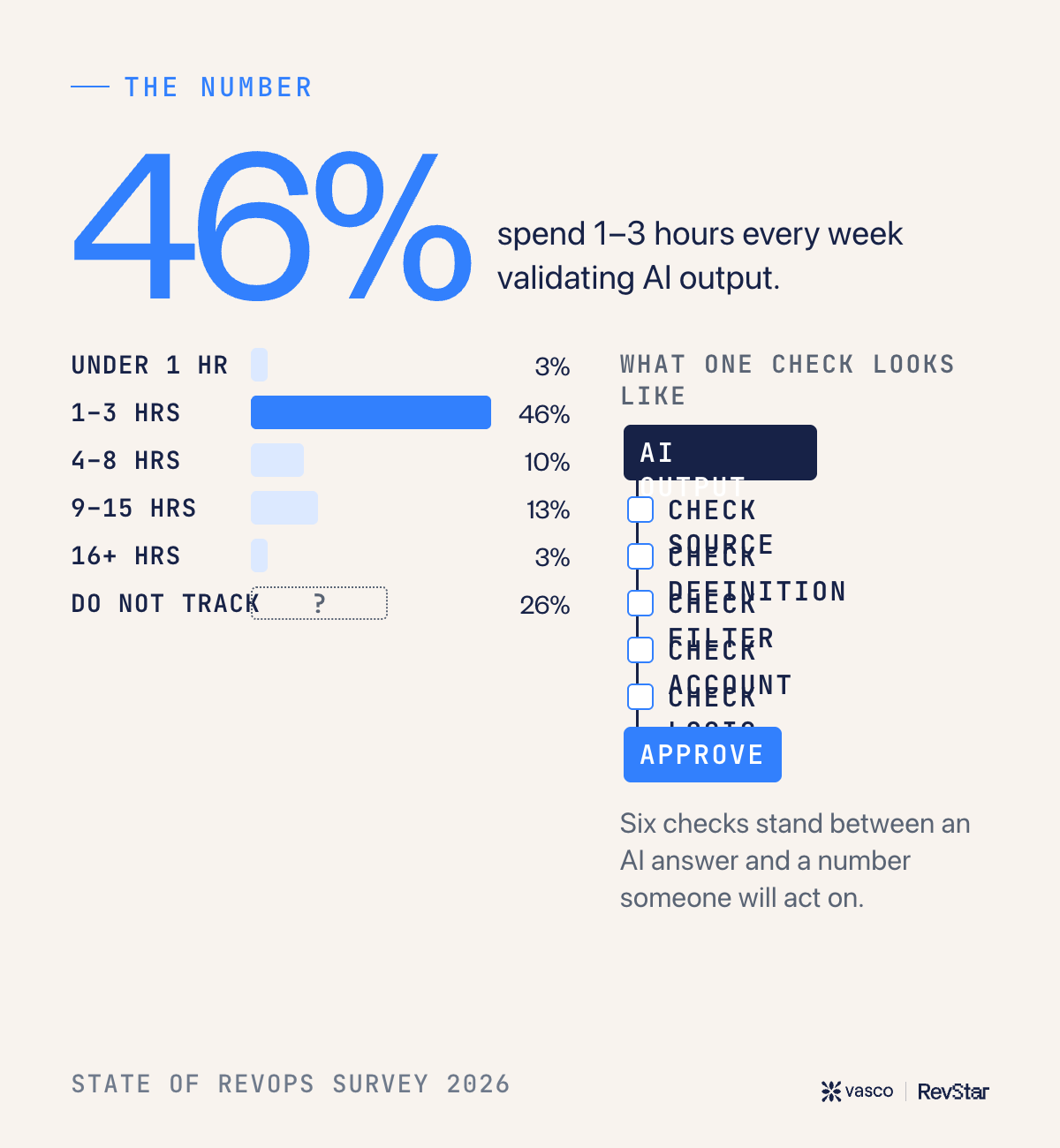
Forty-six percent of respondents spend one to three hours a week checking AI output. Another 26% spend four hours or more.
The remaining 26% do not track the time.
That last number is easy to overlook. Validation can look like productivity because it is embedded inside a task that has already become faster.
Sam Slater describes it as "reduced time from their perspective." A task that once took an entire day may now take a few hours of generation and review. The review feels smaller, so it often disappears from the calculation.
- RevOps meeting
What would it take to reduce the checking?
Revenue teams are compensating manually for context their systems do not reliably hold.
That leads to the central question of the second half of the report:
what changes when the underlying context becomes consistent, defined, connected, and traceable?
An agent can then work from the organisation's definitions, understand relationships between records, connect signals across systems, and show the evidence behind an answer.
The objective is reducing the amount of interpretation a person has to perform after the answer arrives.
Guillaume Jacquet describes governance in practical terms:
"You need to lock the definitions. What is a marketing qualified lead? What is an ICP? How do you calculate net revenue retention?"
Those decisions determine what an agent can understand consistently and, ultimately, what it can be trusted to do.
What to explore in the full report
- Why "five different versions of Acme in four different tools" have to become one before an agent can reliably identify patterns
- Dr. Dan Patterson on the controls that need to accompany increasingly capable AI systems
- How LeanScale reduced a go-to-market diagnostic from weeks to 48 hours
Related reading
- Claude Cowork is impressive — here's the infrastructure it assumes you already have A field report on the gap between a confident AI answer and the underlying number.
- Centralized vs. decentralized AI in GTM: In conversation with Kyle Norton Kyle Norton on who should own AI across a go-to-market organisation.
- Inside the first wave of GTM-built AI agents Examples of the agents revenue teams have already built and the work they are using them for.
See where your team stands. Benchmark your answers against other revenue professionals and get a personalised view of the trust gap.
Parts 5 and 6: Who owns the context, and what it enables
The final two Parts turn to the organizational questions behind that gap: who owns the definitions and context AI depends on, who is accountable when an AI-generated number is wrong, and what revenue teams can do once those foundations are in place.

The full report includes:
- RevOps is moving closer to the decision. Why 51% say RevOps has more influence, and what that means as AI takes on more revenue work.
- Who owns the AI number? Half of respondents report that accountability for a wrong AI-generated number is either undefined or not formally assigned. At companies with $100M+ ARR, that rises to 9 of 12 respondents.
- RevOps writes the rules agents run on. Six experts examine the role of definitions, governance, and the metric passport.
- What reliable context enables. A look at a churn agent and the signals it can connect across a customer relationship.
- One shared context layer, not dozens of disconnected agents. Why adding more point agents does not automatically create a coherent system.
- Measure outcomes, not usage. Only 38% of respondents are confident their AI work is delivering measurable value. The report outlines the measures that can replace activity metrics.
- Put the findings into practice. Eight questions to ask before adding another AI agent, followed by a six-step field guide.
Why RevStar and Vasco ran this survey
RevStar brings together revenue leaders, founders, and investors through its annual summit, meetups, and workshops.
The partnership with Vasco was built around a practical question facing revenue teams: how are organizations actually using AI, and what happens when they do not fully trust the systems underneath it?
The survey asked 39 revenue professionals about AI adoption, trust, data quality, validation work, and accountability. Seven experienced operators then provided context around the findings.
For Vasco, the research addresses a related question: what does an AI agent need to know before a company can rely on its output?
About Vasco
Vasco provides a revenue context layer for GTM agents, connecting the definitions, relationships, and business context that agents need to work across revenue systems.
In one comparison using the same Claude model and the same monthly business review, 21.9% of answers were correct when Claude worked from raw CRM and Stripe data, compared with 99.5% when it worked from the Vasco context graph.