Centralized AI vs decentralized AI is the most important infrastructure decision a go-to-market team makes right now. Most teams start with the decentralized version by default: everyone gets a cloud license, every rep builds their own tools, and the org waits to see what sticks. That approach spreads AI literacy fast, but it rarely moves metrics.
Centralized AI works differently. A small team of specialists builds shared systems on a common data layer, and every agent, report, and workflow compounds on the same foundation. Owner.com, one of the most AI-native go-to-market orgs in B2B SaaS, built this way. The result was 20x ARR per dollar of AE compensation and $102K in closed-won ARR per BDR per month.
This post breaks down why the gap exists, how to close it, and what to build and buy on the way there.
Why decentralized AI often stalls
The decentralized approach gives every rep room to experiment with ChatGPT, Claude, and automation platforms. That freedom sounds attractive. It also creates a few predictable problems:
- Teams duplicate work
- Outputs vary widely and quality stays uneven
- Data quality breaks down without shared definitions
- Results stay trapped in one-off chats and workflows
- Metrics do not change
Kyle Norton, CRO of Owner.com, has seen this play out at company after company:
"You can have everybody doing all this AI stuff, all these reps are posting their skills and workflows in the Slack channel, and it's really exciting…but your metrics will basically the same as where they were before."
The pattern is consistent: excitement without business impact, demos stuck at 80% good. That last 20% determines whether your AI experiment goes to production, and it takes most of the effort and skill.
Why centralized AI compounds
Centralized go-to-market AI means one team, typically applied AI engineers or GTM engineers, building shared systems for everyone. Those systems connect to the right data, follow governance rules, and feed back into a common context layer that every agent draws from.
Kyle is direct on the quality difference. "What an applied AI engineer builds isn't just going to be 20% or 30% better," he said. "They're going to build something that's 5 or 10x better, or maybe 100x better, because if the baseline is almost zero value, what those people build is so much higher that it was essentially a waste for anybody else to attempt it."
The compounding effect comes from architecture. Centralized data shares context, reuses memory, and improves together, so every new agent makes the others more accurate. Decentralized systems build in parallel but never connect.
What is the AI maturity ladder for go-to-market teams?
The AI maturity ladder maps four stages of adoption, from using AI as a search replacement to running a self-improving GTM system. Most go-to-market teams sit at stage two. Fewer than 2% reach stage four.
The framework below draws on Brendan Short's The Signal.
The dabbler: using ChatGPT instead of Google
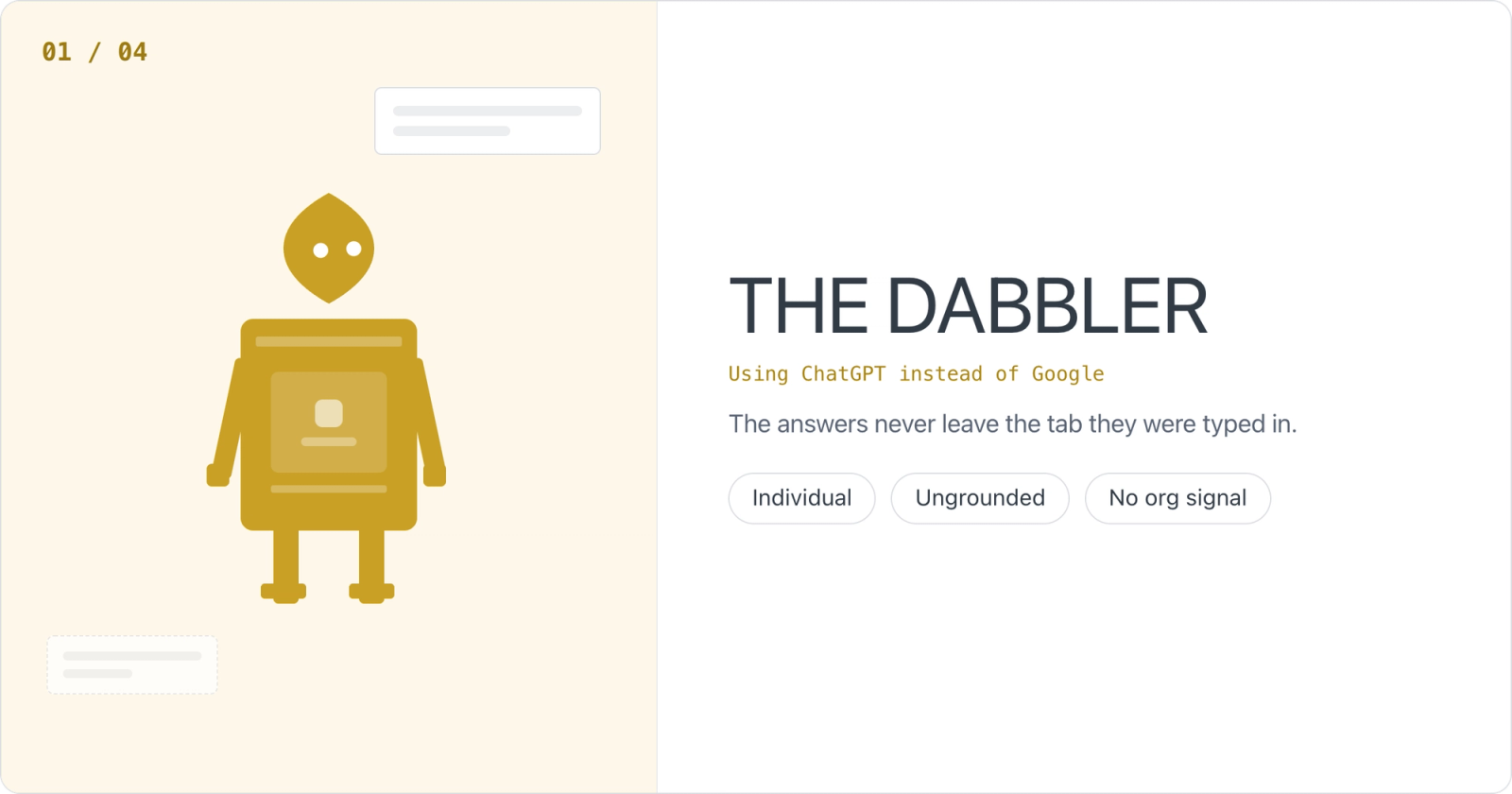
The dabbler uses AI to answer questions instead of search, and nothing connects back to the business. Useful for individuals, but invisible at the org level.
The tinkerer: scattered tools
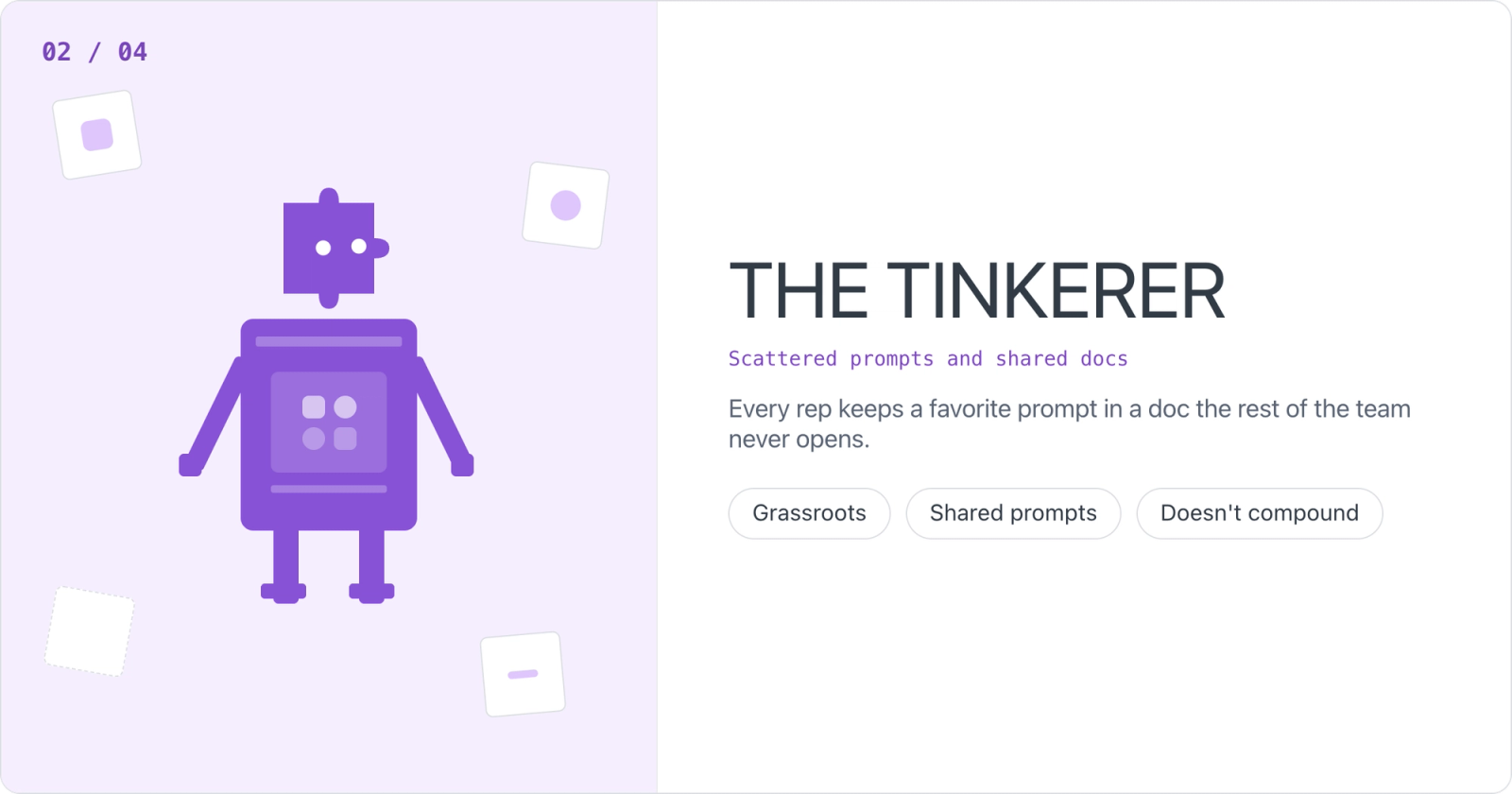
Teams build prompts, chats, and skills for tasks like pre-call prep. People share what they build, but the effort stays grassroots. This stage struggles to improve outcomes without an infrastructure to the way GTM works across functions.
The automator: workflows
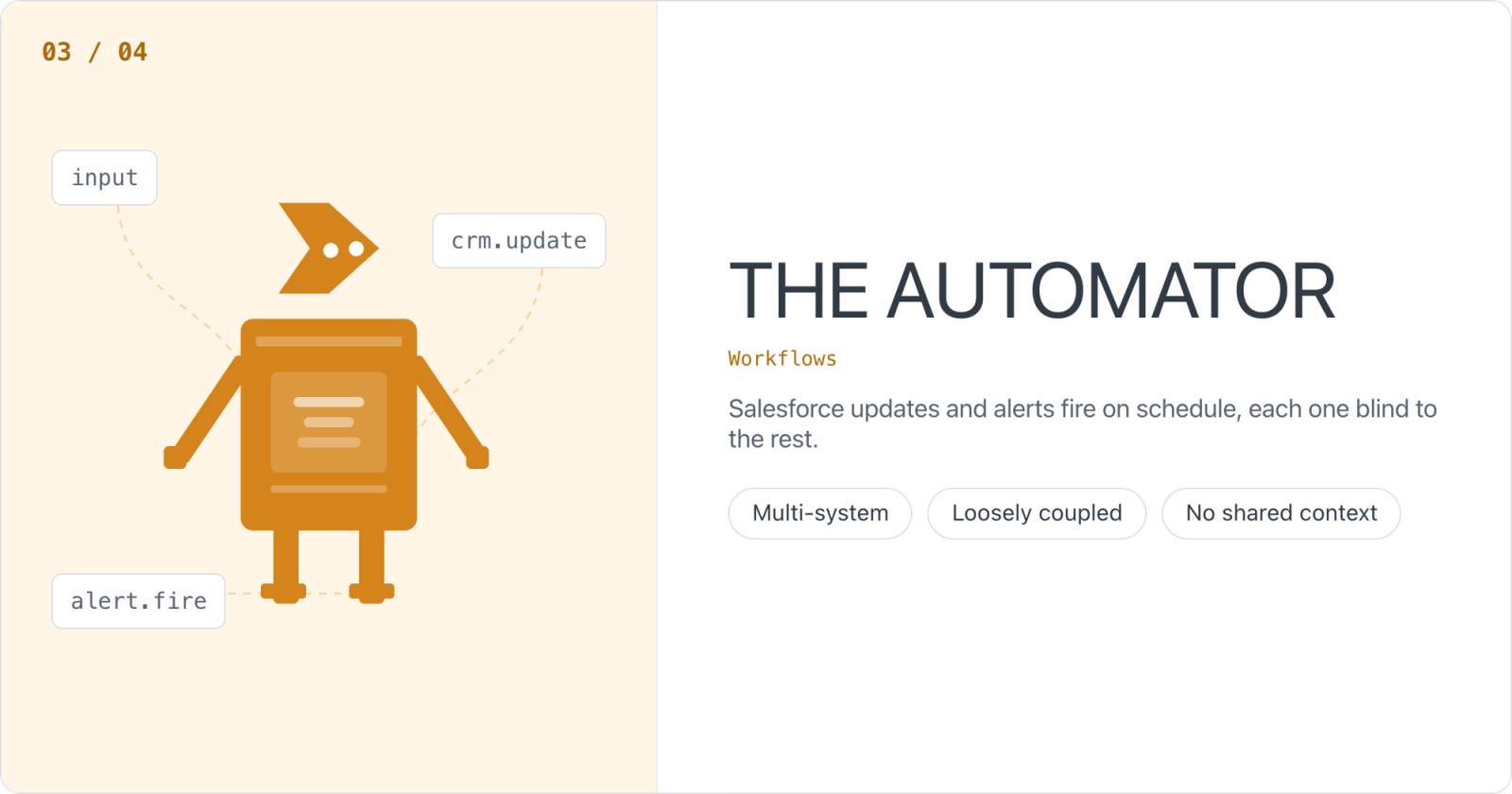
Teams build automated workflows that connect multiple systems: inputs become outputs, Salesforce gets updated, and alerts fire. It’s useful, but workflows remain loosely connected and don't share context.
The architect: context, memory, governance, and evals
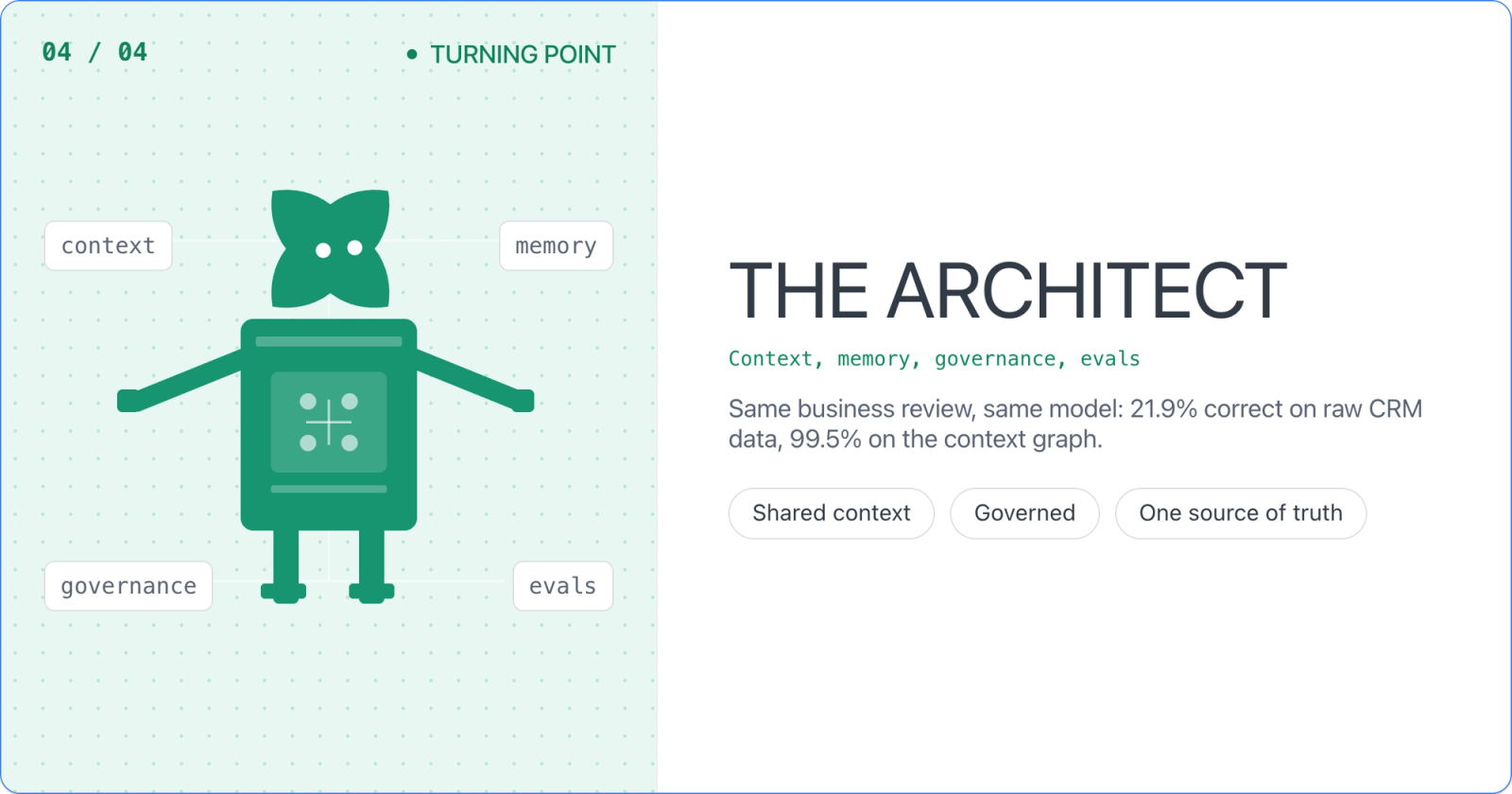
This is the turning point. Go-to-market AI becomes a broader infrastructure layer. Agents share context, central files stay available across the whole system, call outcomes feed back in, and every report and dashboard pulls from the same source of truth.
Kyle describes the shift:
"You have this system where I am controlling the context, curating who can access what information in a thoughtful manner, and that then allows you to get better at everything that is under it: the reports, the dashboards, the automations."
This is also why so few teams reach this stage. Kyle cites the data: 89% of AI agents never ship to production, and most orgs can't name the ROI from the agents they've deployed. The bottleneck is always the same: skipping the infrastructure layer.
Why the gap from 80% to production is bigger than it looks
"It takes minutes to get something from 0 to 80% good with AI," Norton said. "It's really hard to go from 80% done, which is actually not really good enough to be in production. If something is wrong 20% of the time, you have so much human in the loop that it wasn't even worth automating in the first place."
Production-ready go-to-market AI requires strong access controls, accurate data, proper context, testing and evaluation, reliable workflows, and clear ownership. Most teams never invest the hours to close that gap. That's why 53% of go-to-market teams report no measurable return from AI investment.
What is the GTM AI harness, and why does it matter?
A production-ready go-to-market AI stack needs more than a model. It needs a harness: the scaffolding that directs a model's raw intelligence toward specific, trustworthy outcomes.
The model
The model provides intelligence. It can answer questions, generate content, and reason across tasks. Without direction, it hallucinates, over-generates, and produces answers that look right but aren't.
The harness
The harness includes tools and connectors, roles and permissions, governance, context curation, and access controls. Here’s Kyle’s analogy:
"The model is like the wild horse, and you need to put a harness on the horse. They need a bit, and you need reins, and a saddle and stirrups. That is how you take the wild power of a horse and direct it for some outcome."
Claude and ChatGPT are themselves harnesses: they take a model and add connectors, guardrails, and web access on top.
Context
Context is the information an agent needs to reason accurately: customer data, ICP definitions, positioning, competitor handling, product how-tos, table definitions, and plan targets. This is what separates a real answer from what Kyle calls "AI slop answers that lead you astray."
Memory
Memory stores what the system learns over time, avoiding repeated failures and reusing what works. Short-term context (conversation history) and longer-term memory (learned patterns, past outcomes) both matter for go-to-market AI that improves.
Evals
Evals are tests. They confirm whether an agent does its job correctly, and their output feeds back into improvements. Only 37% of go-to-market teams run evals today. That single gap explains most of why 53% see no return.
What is a context graph, and why does RevOps need one?
A context graph is the data foundation that makes go-to-market AI trustworthy.
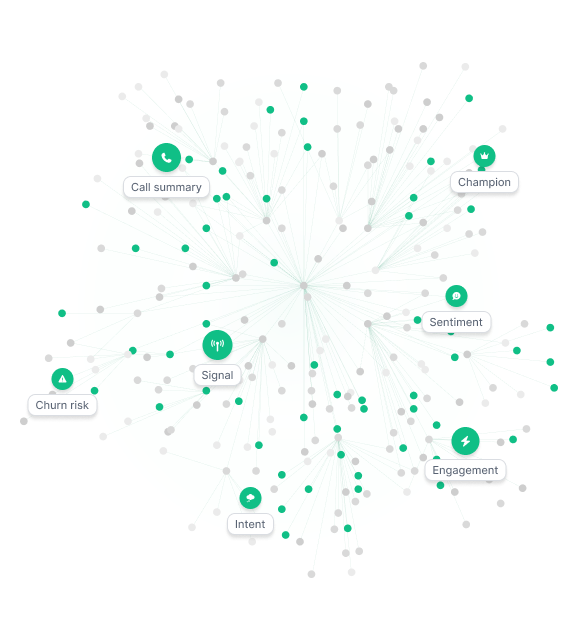
Without one, agents query CRM, Gong, Slack, and Snowflake in isolation, reconcile nothing, and return answers that sound confident but contain errors.
Norton describes the failure mode directly:
"You're querying your Snowflake instance or Salesforce because it's easy to set up those MCPs, and then when you get back this really compelling analysis, and then half of it is wrong."
The cause?:
"You don't have this harness above it, which is telling the agents what is what in your data ecosystem and what information is up to date and what not and what tables they should access. You start to see this all disintegrate."
A context graph resolves this by resolving identities across all revenue systems, rebuilding the account timeline, holding company-specific metric definitions, recording current account status, and linking targets, plans, and performance gaps. Think of it as a semantic layer purpose-built for agents, not a generic data warehouse schema bent into shape.
Vasco handles identity resolution across all revenue systems, rebuilds the account timeline, holds plan targets, and tags every deal outcome against billing.
"It is the line we already draw at Owner. We buy our GTM context graph, so we can build our agents on top."
What should go-to-market teams build vs buy?
Five questions determine which side of the line a tool sits on: How critical is uptime? Does building give you something genuinely unique? What is the real engineering ROI? Does it produce intelligence reusable across surfaces? Does owning it give you an edge a vendor cannot replicate?
Buy when uptime matters, differentiation is low, and the engineering cost outweighs the gain. A dialer, a data warehouse, and a context graph platform all pass this test.
Norton is blunt:
"Don't bother rebuilding Snowflake. Just buy Snowflake."
Build when the use case is custom to your environment, the build is tractable, and the output moves a meaningful metric. Owner.com's pre-call research agent is the clearest example: two weeks of engineering, 85% more calls booked, 85% more opportunities created.
"There's not a lot of people out there that are going to build a tool that is custom for your environment," Norton said. "That's one I can definitely build on my own."
Other strong builds: churn analysis and alerts, custom Slack bots, internal research agents, BDR scoring models.
The principle that holds across both sides: own the intelligence. "You own the plan, you own the metric definitions, you own the ICP," Norton said. "Those are still really core to what you see in the business, and you can't fully delegate that to an agent."
The risk of renting context
If a vendor stores your AI's intelligence in a black box, that context walks when the contract ends or someone leaves. A centralized company brain, one place where agents reuse context, memories compound, definitions stay consistent, and new systems pull from the same source of truth, avoids this entirely. The intelligence belongs to the org, not the tool.
Which AI use cases actually move go-to-market metrics?
"Pipeline saves lives," Norton said. "If you want to reason about where you should apply AI for the most benefit, generating pipeline is pretty high likelihood."
AI for BDR teams
Kyle built a scoring model that ranks hundreds of thousands of prospects and delivers daily prioritized lists to BDRs. The system then synthesizes prospect data and surfaces outreach angles based on shared work history between reps and prospects: if a BDR and a prospect both worked at Stripe in overlapping years, the system flags it. Pre-call research built this way means reps know exactly what to say before they dial.
The result: Owner.com's average BDR closes $102,000 in closed-won ARR per month, or $1.2 million per year. That is not a demo metric.
AI for CRO work
A CRO needs fast answers across many layers of the business simultaneously. A centralized context platform makes self-serve analysis possible, going deep without waiting days for a data team. Kyle says:
"The challenge of being a CRO is you have to juggle a lot. You have to keep an eye on many things, and then be able to go super deep on the one that seems off. Tools like Vasco let you answer those questions on your own without having to ship it to a data team and wait multiple days for an answer."
What business metrics are possible with centralized go-to-market AI?
Here’s Owner.com's full results from the case study:
- 20x ARR per dollar of AE compensation
- $102K in closed-won ARR per outbound rep per month, up from $36K
- 4x closed-won ARR per rep versus direct competitors
- 2x decision-maker connect rate
- In some competitive comparisons, 10x the BDR output of much larger rivals
"If I have 10 BDRs doing what 100 BDRs do at another company," Norton said, "it's just such an advantage." These numbers also free up budget for marketing, brand, and product investment that compounds the gap further.
Which AI agents work in go-to-market today?
Agents that consistently reach production and move metrics:
- AI pre-call research (strongest signal-to-effort ratio)
- BDR scoring and prospect prioritization
- CRO briefing and self-serve revenue analysis
- Internal research and competitive workflows
- Custom Slack bots built on company-specific context
These work because they connect to company-specific context and feed learning back into the system.
Which AI agents aren't ready yet?
Inbound lead follow-up agents and agents that call prospects directly still face real reliability challenges. Norton's framing: "I would be careful not to say that doesn't work. It's like, that doesn't work right now. Things change so fast." What fails today could be standard practice in 12 months. Treat these as watch-list bets, not dismissals.
Buy to remain competitive
Centralized AI in go-to-market does not just organize tools. It creates a system that learns, improves, and supports better decisions over time. Reaching the architect stage, building a context graph, making clear build-vs-buy decisions, and keeping the company brain in one place all point in the same direction: compounding business impact.
As Kyle put it:
"Centralized AI is the thing that's gonna get you to compound."