
A pattern is emerging from the first wave of GTM teams building AI agents inside Vasco: teams are moving beyond experimentation and creating systems that monitor, analyze, and improve revenue operations.
After launching AI agent capabilities, Vasco analyzed 10 weeks of builder activity across 37 organizations. During that period, teams created roughly 180 custom AI agents.
The data reveals two clear behaviors. Most teams start with proven templates, but the teams building the most sophisticated systems create custom agents around problems unique to their revenue motion.
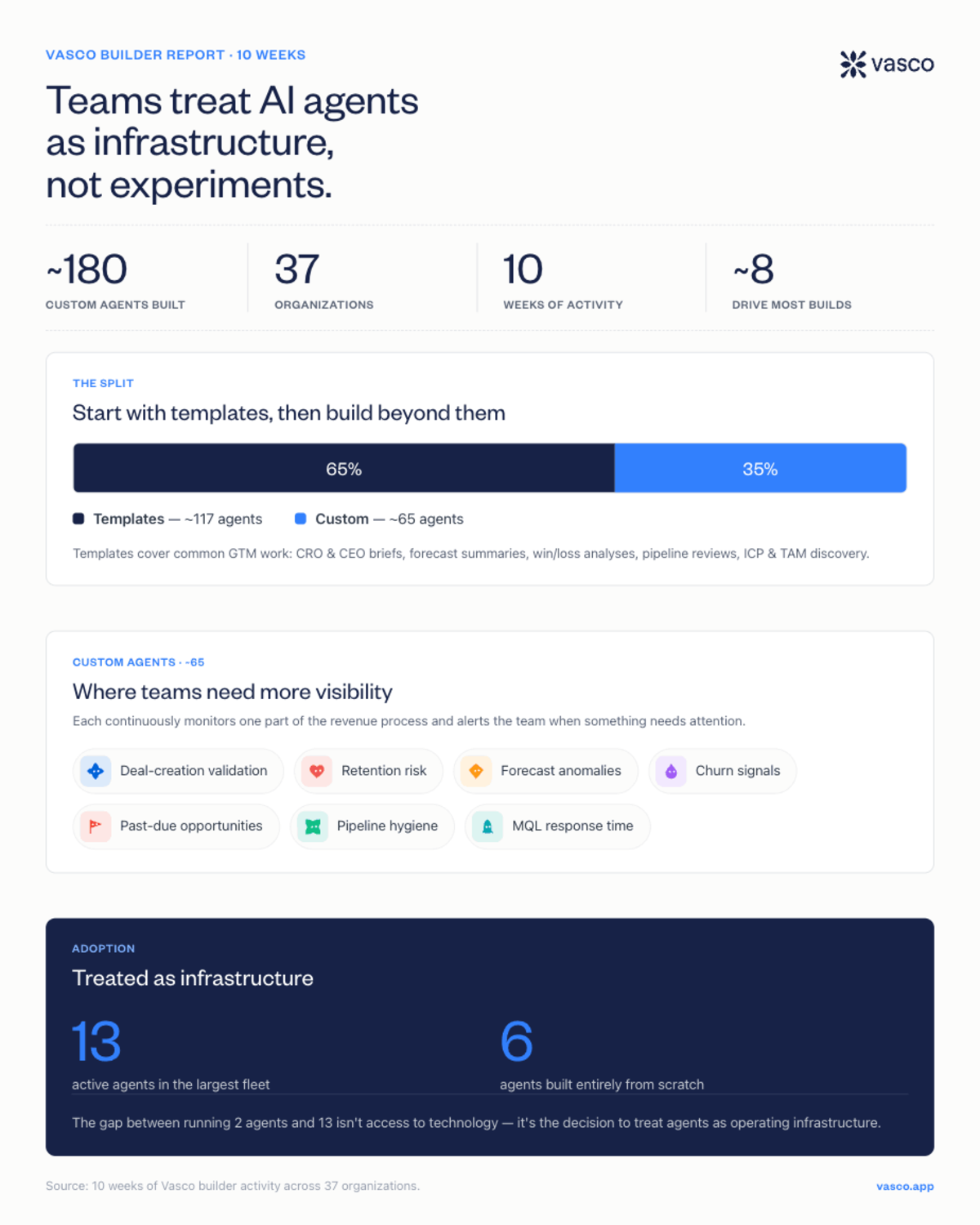
Teams start with templates, then build beyond them
About 65% of the 180 agents created during this period were based on existing templates, including CRO and CEO briefs, forecast summaries, win/loss analyses, pipeline reviews, and ICP and TAM discovery.
Templates work because they solve common GTM problems quickly. Several teams created multiple versions of the same template to support different business units, sales motions, or reporting needs.
The remaining 35%, or roughly 65 agents, reveal a different pattern. These agents were built from scratch to solve specific operational gaps that teams could not address with a standard workflow.
Custom agents reveal where GTM teams need more visibility
The custom agents built by teams share a common purpose: they continuously monitor a specific part of the revenue process and alert teams when something requires attention.
Teams built agents that validate deal creation, monitor retention risk, detect forecast anomalies, track churn signals, identify past-due opportunities, audit pipeline hygiene, and analyze MQL response times.
These agents are not replacing existing reports. They are watching for changes that are easy to miss when teams rely on manual reviews.
Scheduled agents are becoming part of the operating system
The difference between a useful AI agent and a trusted AI agent is whether the team can rely on its output without checking every answer.
“Everyone can build something that looks right in a demo. The hard part is building something that’s right at 7am on a Monday before anyone’s logged in. The teams we see going deepest aren’t asking how to get an agent to run. They’re asking what that agent needs to know to be trustworthy.” – Guillaume Jacquet
At least 10 organizations now run agents on recurring schedules. These agents operate before teams start their day and surface issues before they appear in a pipeline review, forecast meeting, or renewal discussion.
They go beyond answering questions on-demand to continuously monitor the business and surface changes before teams need to ask.
The teams building the most agents treat them as infrastructure
Agent adoption varies across organizations. Around 8 companies account for most of the 180 agents created during this period.
The largest Vasco builder has 13 active agents. The most customized deployment has 6 agents built entirely from scratch, effectively turning Vasco into a custom RevOps monitoring layer.
The difference between organizations running two agents and those running thirteen is not access to the technology. It is the decision to treat agents as part of the operating infrastructure.
The teams building the most agents start with a specific operational problem, create an agent to solve it, and continue expanding from there.
AI agents are limited by the context they receive
The biggest constraint on AI agents is not the model. It is the information the model has available when making decisions.
An agent connected only to CRM data does not understand the meaning behind the fields it reads. It does not know that a “verbal commit” deal has been stalled for 90 days, that an account has changed segments, or that different teams interpret pipeline stages differently.
The output can still look polished. The answer can still be wrong.
For RevOps teams, hallucination rarely appears as obvious nonsense. It appears as a confident recommendation built on incomplete information.
The custom agents built during this period point to the same conclusion: teams need a reliable context layer before they can trust AI agents with revenue decisions.
They are defining business rules, connecting related records, reconciling account identities, and giving agents a current view of their revenue motion.
The scheduled monitors posting to Slack every morning are valuable because teams trust the information behind them.
The investment is not just in building more agents. It is in giving those agents the context required to make accurate decisions.