The real shift AI has brought to forecasting is hallucination. There was an old failure mode where a forecast nobody quite trusted was patched over every Monday with a round of guessing about why a deal moved. The new failure mode is a forecast everybody trusts by default, because it came out of a system, and systems sound authoritative even when they're wrong.
Both failures trace back to the same root cause: nothing in the data distinguishes a number grounded in a real signal from a number that's just confident. Fixing that is a governance problem, not a smarter-model problem, and it's the gap this guide addresses.
What is provenance?
Provenance is the documented history of where something came from and what happened to it along the way. The word comes from art and antiques: a painting's provenance is the chain of ownership and custody that proves it's genuine and not a forgery someone assembled to look convincing. Apply that same idea to data, and provenance means the record of where a piece of information originated, who touched it, what changed, and when, kept well enough that anyone can trace a current number back to its source instead of just trusting that it's right.
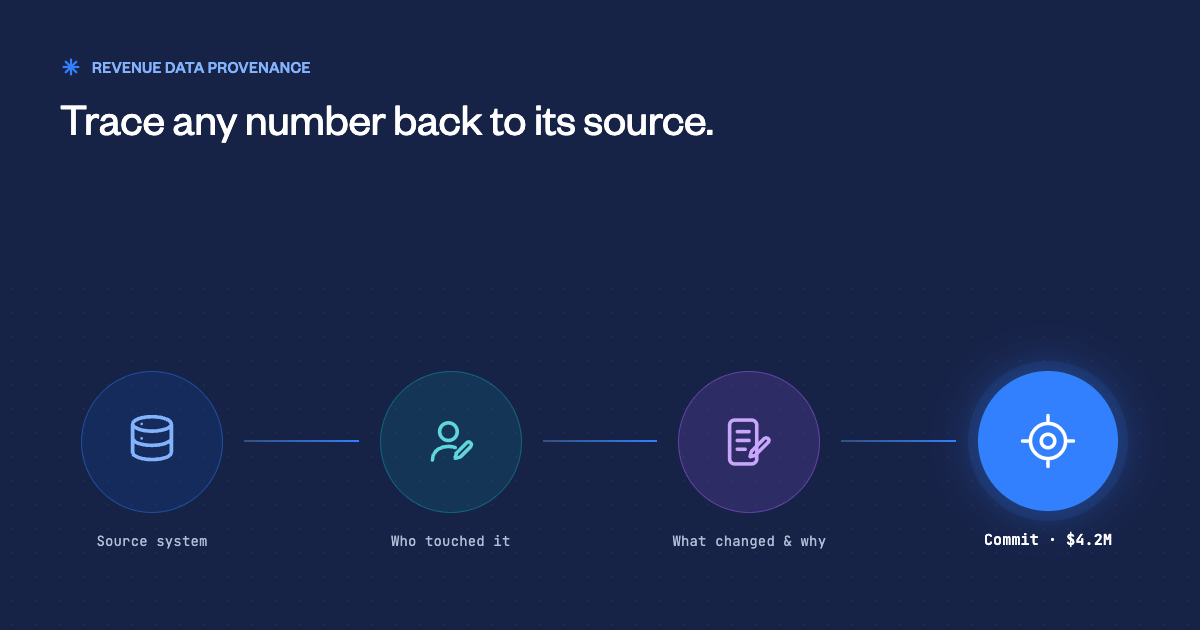
The reason this matters more now than it did five years ago is straightforward: a forgery only fools someone if nobody checks the paperwork. The same is true of a data point. As long as a person is the one reading a report and deciding whether to trust it, a gap in the paper trail is a nuisance. Once a system starts acting on that number without a person in the loop first, the gap becomes the whole risk.
Data provenance is no longer a back-office conversation
Enterprise AI leaders outside of RevOps are already having this conversation, and it's worth borrowing their vocabulary. A recent Forbes Technology Council piece argues that as AI moves from generating answers to taking action, the important question stops being what the model can do and becomes what data made the system act. The author calls data provenance the trust layer for agentic AI: the record of where data came from, who changed it, and which decision it influenced. He points to Gartner's projection that agentic AI will sit inside a third of enterprise software by 2028, up from under 1% in 2024, and to IBM research finding that most breached organizations studied had no AI governance policy in place at all.
Revenue data provenance is that same idea applied to the system every CRO already depends on. A pipeline, a forecast category, a rolled-up ARR number: each one is a decision an agent might soon be making or influencing directly. If the enterprise-wide argument holds, and the evidence above suggests it does, then a forecast is exactly the kind of decision that needs its data history on record before an agent starts acting on it, not after.
What actually builds trust in a forecast?
A forecast has revenue data provenance when every number in it can be traced back to where it came from: which data sources fed it, which agent or person touched it, and what it was checked against before it reached a report.
In practice, that's the answer to "who changed what, when, and why" for every figure that lands in front of a board.
A forecast with that record intact can be walked backward, category change by category change, to source. A forecast without it is a confident guess with good formatting, and no algorithm sitting on top of ungoverned data fixes that. Governance earns the trust back. Better math doesn't.
Why AI forecasts fail an audit today
Most revenue stacks were never built to answer "where did this number come from." A handful of gaps show up on repeat.
Forecast categories were never defined as falsifiable conditions.
"Commit" should mean a specific, checkable state has been reached: a signed verbal agreement with procurement in legal review, for example, not "I feel good about it." "Best Case" should mean a named next step with a date attached, not a vibe. If a deal can move category without meeting a stated condition, the category is decoration, and every roll-up built on top of it inherits that ambiguity.
The CRM stopped reflecting reality.
CRMs track deal stages, not the consumption and billing events that now drive ACV in a usage-based world. The data that explains a customer's real state increasingly lives in billing and product systems that never talk to the CRM the way RevOps needs, which is why more operators pull straight from the warehouse where those signals actually converge. This is a pipeline data quality problem before it's ever an AI problem: an agent reasoning over stale or fragmented data will produce a confident forecast that's wrong in exactly the same way a human's would be, just faster.
Category changes happen with no reason attached.
A deal moves from Commit to Best Case, and the only record is the new value. The old value, who changed it, and why are gone the moment the field is overwritten. Without that trail, a category change grounded in a competitor win looks identical to a category change grounded in a rep protecting their number.
Verification happens by hand, quietly.
Teams add a manual check on every AI-generated output because nobody fully trusts it went in clean. That's a symptom. The audit trail lives in someone's head instead of in the system, and it disappears the day that person is out before the board meeting.
Signs your forecast has no audit trail
- A category change gets a guess in a pipeline review, not a documented reason.
- Nobody can say what share of open pipeline changed category in the last seven days, or why.
- Finance overrides the field's number so often, or so rarely, that nobody can tell if it's adding judgment or just rubber-stamping.
- A metric discrepancy sat in the board deck for two quarters before anyone caught it.
- The pipeline review spends most of its time reconstructing what happened last week instead of deciding what to do about it.
If two or more of these are true, the forecast is not auditable. It just looks finished.
The mechanisms that make a forecast defensible
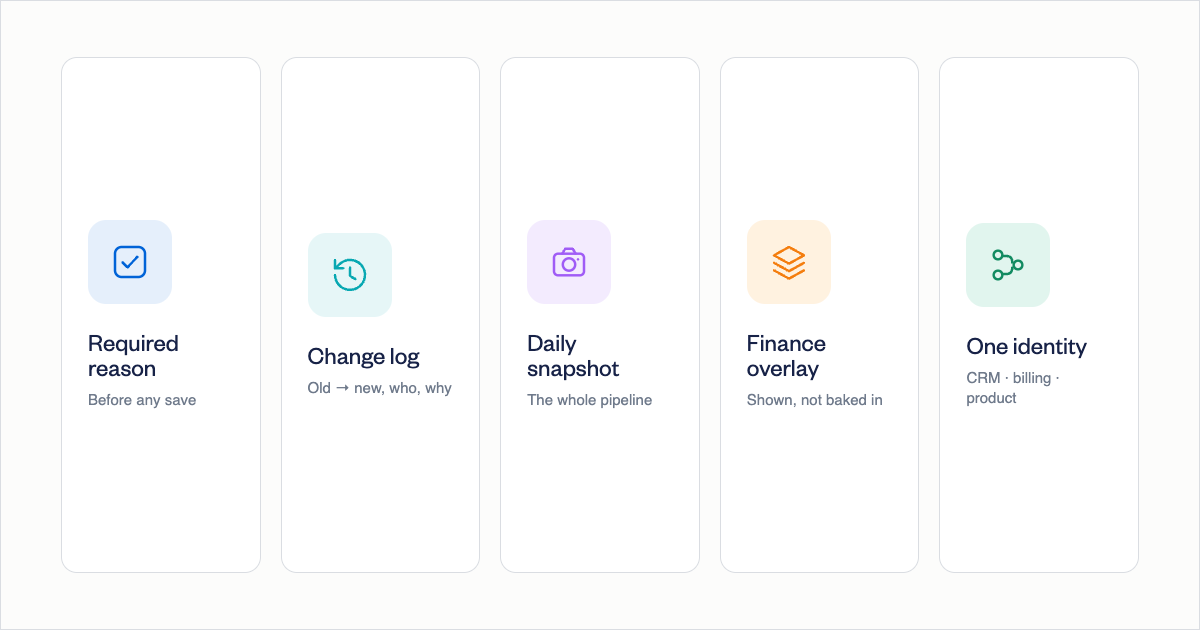
Revenue data provenance comes from a small set of concrete mechanisms, not a principle, and each one closes a specific hole.
A reason required on every category change, before the system lets it save.
When a rep moves a deal from Commit to Best Case, they pick a reason from a short list (competitor selected, budget delayed, champion left) before the change goes through. No reason, no save. This cannot live as a rule people are supposed to remember. Rules get followed until quarter-end pressure hits, then they don't. A change that simply won't save without a reason gets one every time, from every rep, without anyone having to police it.
A permanent record of every category change, kept separate from the deal itself.
Old value, new value, who made the change, when, and why, written somewhere nobody can quietly edit or delete later, including admins. If something needs correcting, a new entry gets added, not a rewrite of the old one. This is the difference between a history you dig for after something goes wrong and a history the team actually reads every Monday.
A daily snapshot of the entire pipeline, filed away by date.
What every open deal looked like, category, amount, close date, owner, saved once a day. The change record tells you what moved and why. The snapshot lets anyone pull up exactly what the pipeline looked like on any past date, so a board member's "why did this move so much since last month" question gets answered by pulling a report, not by reconstructing a memory.
Finance's adjustments shown alongside the field's number, not baked into it.
When finance revises a rep's or a manager's rolled-up figure, that adjustment gets recorded on its own, tied to a specific quarter, with a reason and a name attached. The original number underneath doesn't get overwritten. A report can then show both, the number the field reported and the number finance settled on, so anyone can see exactly where a human judgment call was applied versus where the number is a straight calculation.
One customer record, not three that quietly disagree.
The same account should look identical whether you're reading the CRM, the billing system, or the product usage dashboard. Without this, a churned customer can still show up as "active" in one tool while billing has already stopped charging them, and a forecast built on top of that mismatch is wrong before anyone even looks at pipeline. This is usually the least visible gap on this list, because each system individually looks fine. It only shows up when someone tries to reconcile them and the totals don't match.
Miss any of these and the forecast has a hole an auditor, or a skeptical board member, will find.
Governance: who owns the audit trail?
Mechanisms only hold up if someone owns running them. A governance model for AI-assisted forecasting needs the following in place before agents start reading and writing pipeline data at scale.
"Governance sounds like a compliance function until the board asks why a number moved and nobody in the room can answer. Then it's the only thing that matters. We didn't build reason codes and change history because it's good practice. We built it because 'the AI said so' isn't going to hold up to a CFO." — Guillaume Jacquet, CEO of Vasco
A single definitions registry, with one accountable owner.
Every forecast category, and every metric derived from it, gets one falsifiable definition, stored in one place, that every tool and every agent reads from. RevOps owns changes to it. No team maintains its own local version, and no agent is allowed to infer a definition that isn't written down.
A human check before a pattern becomes an automated rule.
Say an agent notices that deals with a security review scheduled early close 30% more often. Before that observation gets turned into an automatic playbook step, someone on RevOps checks whether it holds up, or whether it's five deals out of a hundred that happened to line up that way. Skip this check and agents start automating on coincidences, then reporting those coincidences to the board with full confidence.
A recalibration cadence on a fixed calendar.
Markets shift and definitions age. Review fast-moving metrics like category flip rate monthly. Review structural definitions like what counts as Commit quarterly, unless a market shift forces an earlier look. When a previously reliable pattern weakens, the review should catch it before a playbook keeps running on a stale assumption.
Escalation thresholds, written down before a miss happens.
Decide in advance what forces a manual review: more than a set share of current-quarter pipeline flagged as slip risk, a deal that has moved category twice with no resolution, or any top-five deal by ARR with no scheduled next step. Thresholds set after a bad quarter are damage control. Thresholds set in advance are governance.
Instrumentation: the numbers that show whether this is working
Five figures tell you whether these mechanisms are actually in place or just documented on paper.
- Category flip rate. The share of open pipeline that changed category in the trailing seven days. A healthy pipeline moves. Deals should shift category as facts change, and the number to watch is spikes right before quarter close, which usually signal last-minute cleanup rather than real movement.
- Reason-code compliance. The share of category changes carrying a specific reason rather than a catch-all or blank field. Below roughly 90%, the reason list or the enforcement point needs a second look.
- Override rate and direction. How often finance adjusts the field's number, and which way. A number that never moves means finance isn't adding judgment. A number that moves constantly in one direction points to a structural disagreement between the field's incentives and finance's caution.
- Forecast-to-actual variance. For closed deals, how far the category assigned thirty and sixty days out diverged from the actual outcome, broken out by rep and manager. This is the only honest measure of forecast accuracy once these mechanisms are in place.
- Review meeting duration. A blunt but telling signal. A pipeline review that used to run the better part of two hours and now runs thirty minutes has stopped re-litigating totals and started doing forecast inspection: working a short list of unexplained changes instead of reconstructing the whole quarter from memory, which is the actual point of the exercise.
Why this matters more once agents are in the loop
The confidence problem described up top is measurable, and the numbers are stark. Agents connected directly to raw CRM data with no governance layer underneath answer basic revenue questions correctly around half the time. Add a reconciled data layer, definitions, source tracing, and change history purpose-built for agents to reason on, and accuracy on the same questions climbs above 95%. While the model itself stays the same, accuracy swings based on whether the data underneath was built for a system that acts on it at face value, not a person who might double check.
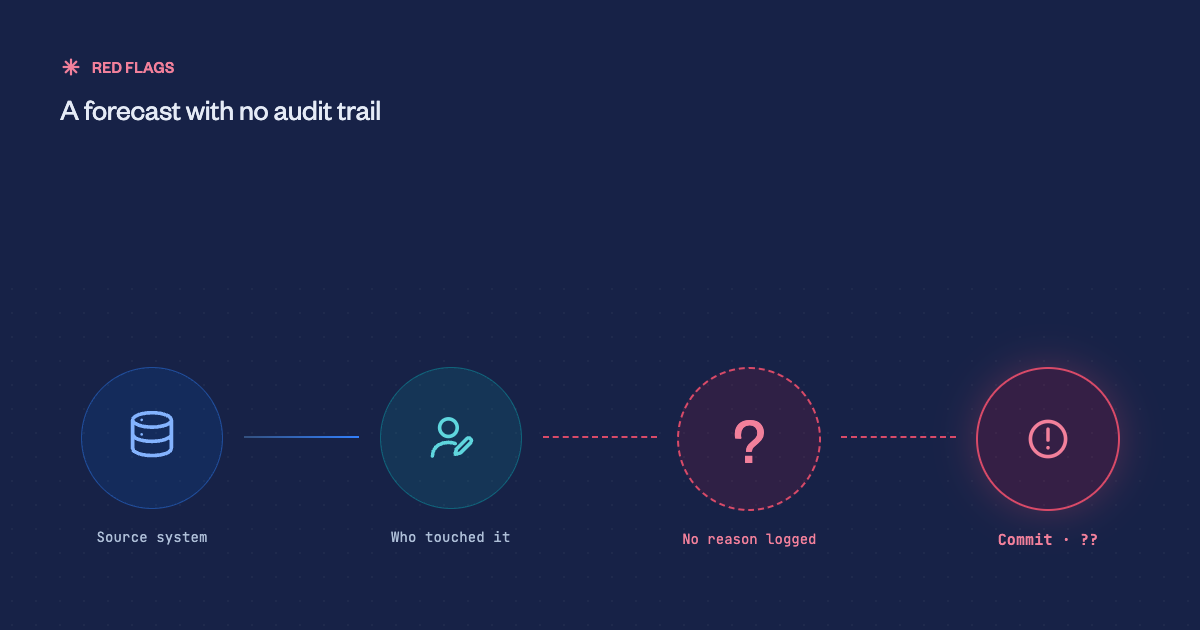
That's the case for treating the revenue data layer as its own piece of infrastructure, not an afterthought bolted onto the CRM. In practice, that means a revenue context layer sitting between the raw systems and the agent: one place where identity is resolved, definitions are fixed, category changes carry a reason, and every number can be traced back to where it came from. The agent still does the reasoning. The context layer is what keeps that reasoning honest. Once an agent is reading pipeline data and writing forecast updates, every mechanism in this guide, required reasons, permanent change history, daily snapshots, reconciled identity, stops being a nice-to-have audit trail and becomes the thing standing between a board getting a real number and a board getting a confidently wrong one.
A revenue data provenance checklist for CROs
Before the next board review, walk through each of these:
- Can any reported number be traced to its source system in under two minutes?
- Does every category change require a reason before it saves, rather than relying on reps to remember?
- Can the team pull up exactly what the pipeline looked like on any past date, not just today?
- Are finance's adjustments visible next to the raw number, rather than written over it?
- Are escalation thresholds for slip risk and stalled pipeline written down and reviewed on a fixed cadence?
- Would a new hire, or a new agent, get the same answer to "what does Commit mean" no matter which tool they asked?
A no on more than one of these means the forecast is running on trust the team hasn't actually earned yet.
Fix the trail, not the model
A required reason on every change, a permanent record of who touched what, a daily snapshot to reconstruct any past state, one reconciled identity behind every account: four habits, not a better model. Together they're what revenue data provenance actually looks like in practice, and they turn a number nobody can defend into one that traces cleanly back to source.
The stakes are higher now because agents read and write that data faster than any human can keep up with, and a confident wrong summary doesn't invite the scrutiny a rep's guess would. Start with one change: require a reason before any forecast category can be updated. Everything else here builds on that. Get it in place, and the next time a board member asks why a number moved, the answer is a report, not a reconstruction.