You already know this part. Somewhere in your stack, your functional leads have spent the last year plugging in AI to move faster. Ship more. Hit this quarter's number a little sooner. Marketing set up a lead scoring model. Sales spun up a research assistant. Someone built an agent that flags at-risk deals before you've even opened your weekly pipeline review.
Nobody sat you down and asked whether all of that should be running at once, unsupervised, month after month. It just started happening, function by function, tool by tool. And because everyone's saving time and nothing's visibly on fire, it feels like progress. This time saving however, is arguably a folly and the reason is simple: if these measures were actually effective, then why do we still face a severe revenue challenge?
The grim reality is that what's actually building underneath is a chaotic system nobody truly owns, becoming more and more inefficient, day by day. Your very own GTM Frankenstein machine in the making.
The chaos doesn't look like chaos while it's happening
Take something as simple as call intelligence. One team is on Grain, and another picked Fathom. A third is feeding transcripts into whatever tool someone found last quarter. Every one of those tools is good at what it does. What’s better? If they’re working from the same transcript, the same scoring logic, or the same definition of what a strong call even sounds like.
Four tools, each good at what it does, produces four versions of the truth, quietly drifting apart, with nobody positioned to notice until the numbers stop adding up.
It starts on a Saturday
Here's how it starts: someone spins up an agent on a Saturday. It's live by Monday. No one knows whether it should exist, what data it touches, or who's accountable if it gets something wrong. Multiply that across every function, every quarter, and you don't end up with an AI strategy. You end up with a hundred small, well-intentioned decisions that were never supposed to add up to anything, and now they're running your pipeline.
Leadership then says, “move faster”. Every function picked up their AI tool of choice and started playing. An orchestra where everyone is talented and nobody's reading from the same sheet music simply sounds like noise.
“Everybody in the organization now thinks they have AI superpowers. It's almost like rogue activity where we're all tinkering at weekends, and we're coming back to the office Monday morning going, look folks, I built this agent with a fancy little dashboard. It's just causing organized chaos.” — Dr. Dan Patterson, CIO of Winning by Design
The part that should worry you
There's a real number behind that trap, not just an instinct. In one test, the same AI model was asked an identical set of business questions twice — once against a company's raw, ungoverned CRM data, and once against a version of that same data governed under one locked set of definitions. Against the raw data, it answered correctly about 22% of the time. Against the governed version, 99.5%. Same model. Same questions. The only thing that changed was whether the data underneath it could be trusted.
To this day, most organizations still don't have a single source of truth they can confidently build their growth trajectory on.
AI was supposed to strengthen that single source of truth: fewer human errors, faster revenue growth. Instead, ungoverned AI is quietly bringing the guesswork back, at a scale no human ever could. Every model running without a shared definition underneath - undocumented assumptions about what qualified means, what Commit means, what at-risk means, and how those things behave together instead of in silos. Multiply that across every function running its own AI, and you get the same ungrounded calls the org always made, just faster, dressed up as data-driven, with a lot more conviction behind them.
Confidently wrong, at full volume
And here's the trap: nobody double-checks a system that sounds certain. AI doesn't hedge. It states a lead score, a churn risk, a deal stage, with total confidence. And once those tools are integrated, that confidence looks earned: the AI is pulling from every connected system, so the instinct is always the same. It clearly has the full picture, why bother anyone else with this? That instinct is exactly backward. The more confident the output, the more the inputs into the system should be challenged. Garbage in, garbage out is all too common with AI inference.
There's a real number behind that trap, not just an instinct. In one test, the same AI model was asked an identical set of business questions twice — once against a company's raw, ungoverned CRM data, and once against a version of that same data governed under one locked set of definitions. Against the raw data, it answered correctly about 22% of the time. Against the governed version, 99.5%. Same model. Same questions. The only thing that changed was whether the data underneath it could be trusted.
The forecast inherits every bad call
And it doesn't stay contained to the decision itself. It rolls into the report. A forecast built on five ungoverned AI calls doesn't look uncertain. It looks clean. Nobody questions it, because nothing about it announces itself as a guess. That's the part that should worry a CRO more than any single bad call: the board deck, the QBR, the number everyone nods along to, all of it can be quietly wrong and look exactly like it's right.
The aspiration has to sit on something real
Every CRO walks into the year with a North Star. A revenue target, a growth aspiration, a number the board is expecting. That number only means something if it's reverse engineered with solid reasoning behind it - not simply asserted. What leading indicators does the company need to hit it, what does that require at the department level, and what does that require function by function?
“The same thing pertains to revenue. If our quarterly goal to hit our annual target is say $2 million, that's fantastic. But disseminating that $2 million target into what that needs to comprise: $500,000 from new acquisition and $1.2 million from retention and the rest from expansion, is what gives us the foundation for the longer-term compounding. It's almost like having two goals. Short term, so you check the box on hitting it, but you're getting the right ingredients as part of that goal to support the longer-term compounding.” — Dr. Dan Patterson
Every contributor's number has a bias built into it
None of that math holds if the inputs underneath it aren't trustworthy. “The outputs are highly, highly sensitive to changes in inputs,” Dan explains. “The maths has proven the fidelity of the output is all about the inputs. And the inputs, when we build models, it's the human factor. A lot of contributors will have a natural positive bias. They're essentially protecting their domain.” Ask a marketer for the uncertainty on a conversion rate, and they'll paint the optimistic version, not the honest one, because their number is on the line too.
A North Star built on projections nobody's checked for bias is just an aspiration dressed up in a spreadsheet.
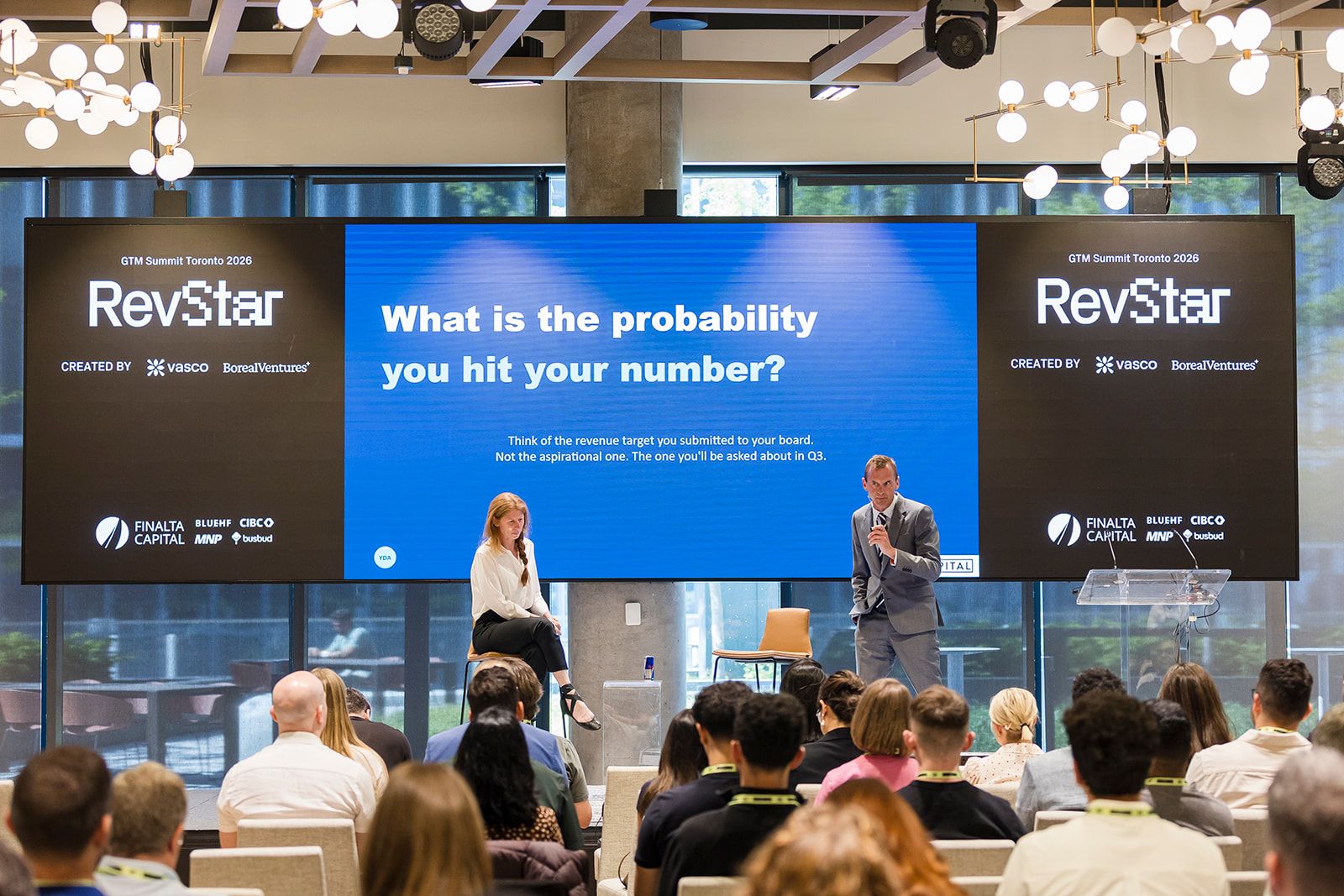
Governance can't stop at the tool. It has to run the whole Bowtie.
Every example so far looks like a separate problem: the lead score, the deal flag, the churn alert. But marketing's lead score, sales' deal stage, and CS's churn model are all reading the same customer at different points in one continuous journey: acquisition, retention, expansion. Govern them one tool at a time and you get four functions each running their own accurate version of the truth, none of them wrong on their own terms, none of them agreeing with each other either.
“Winning by Design has the bowtie, which is trying to drive consistency across those organizations. It enforces commonality in terms of data which translates to effective revenue flow from stage to stage. I don't think those sub-orgs are necessarily tracking the wrong metrics. They're just not consistently tracking and handing off between them.” — Dr. Dan Patterson
That handoff is the part most AI governance conversations skip. It's not enough to define what qualified means inside Marketing, or what Commit means inside Sales. Those definitions have to hold across the handoff itself, Marketing to Sales, Sales to CS, CS to expansion, or the AI sitting on each side of that handoff is quietly building its own version of an Ideal Customer Profile. A single source of truth means a shared model of the entire journey, one every function's AI reads from and writes back to the same way, rather than a dashboard bolted on at the end.
Get that right, and a lead score, a deal flag, and a churn alert stop being three separate bets on three different realities. They become three views into one governed system, running the length of the Bowtie.
Why this problem is yours
If Marketing's AI misjudges a lead, that's a lead quality complaint. If Sales' AI misreads a deal stage, that's a forecasting problem. If CS's AI misses a churn signal, that's a retention miss. Every one of those rolls up into a number with your name on it.
RevOps can build the system. IT can maintain the tool. Neither of them is standing in front of the board explaining why Commit didn't mean what everyone assumed it meant. That's you. Which means this was never a project you could fully delegate. It's a liability you already own, whether or not anyone decided that out loud.
Reverse engineering, not a mandate
The fix looks more like reverse engineering than a top-down mandate or hoping the bottom-up chaos sorts itself out: each function names what it actually needs to move faster toward retention and expansion, RevOps builds the system underneath it, and you review the rules of engagement those systems are running on. Nobody has to shut the agents down. Somebody just has to finally read the sheet music before the next section starts playing, and that somebody is the CRO and RevOps. They're the maestros here.
Everyone else is already good on their instrument. They just need someone conducting.
What it costs when nobody owns this
An Anti-ICP left undefined doesn't just waste a sales cycle. It compounds but in a negative manner. Product ships features that only ever serve one wrong-fit account. CS burns effort trying to satisfy a client who was never going to be satisfied, because the fit was wrong from the start. None of that shows up as a single bad call. It shows up as a hundred small ones, all built for short-term relief, none of them building toward anything.
“You end up having teams working in silos because everybody's after their own numbers and their own vanity metric. And then all of a sudden, what is a sentiment becomes a data proof that something is really broken.” — Yasmine de Aranda, CEO of 360Angle
65% win rate, still losing
We've watched this play out in real accounts. One was generating strong lead volume, closing at a 65% win rate, and still losing. Gross revenue retention had dropped to an all-time low of 75%, and expansion was stalling quarter by quarter. Every function blamed the next one. Marketing blamed lead quality. Sales blamed onboarding. CS blamed the product roadmap.
The real issue was never volume or close rate. It was visibility: into lead scoring, into seller behavior, into how the product was actually being used once the deal closed. The fix wasn't generating more leads. It was seeing, accurately, where they already stood, so they could repeat what was actually working instead of guessing at it again.
This stops being theoretical fast
The board meeting where the forecast doesn't hold, and “the AI flagged it wrong” is not an answer you want to give twice.
The diligence process where a buyer's team asks how deal stages are defined, and the honest answer is “it depends which system you're looking at.”
The quarter an account walks that nobody saw coming, because everyone trusted a churn model that never flagged it.
None of these are hypothetical. They're just not this quarter. Yet.
The foundation, not the fix
What building this actually buys you is the ability to answer three things on demand, at any point, for any AI decision running in your revenue org, without slowing anything down:
- Who owns this call?
- What rule was it made under?
- Can you actually trust the data it was made from?
Yasmine has a name for the state you're in without those answers: the Great Misalignment. Marketing, sales, CS, and product are all optimizing locally — reasonably, by their own logic. Marketing's right by its own math. So is Sales. So is CS. None of them are wrong on their own terms, and that's exactly the problem: nobody governs how the pieces add up.
Zero Churn Architecture is what fixing it looks like in practice: building the system backward from retention and expansion, instead of forward from a single Commit date and hoping the rest holds up behind it. Get the foundation right, and every function is finally building on the same ground.
Right now, most organizations aren't doing that. They're shooting from the hip, one rogue AI agent at a time.
“Today, we have these AI superpowers at our fingertips, but with superpowers we have to have balance and control. As James Bond famously once said, History isn't kind to men who play God” — Dr. Dan Patterson
There are two kinds of CROs
Every CRO running AI across their revenue org already falls into one of two groups. Some have decided, in advance, who's responsible when the AI gets something wrong and what rules it has to operate within. Most haven't — they're running AI across marketing, sales, and CS with no one accountable for catching its mistakes, and no agreement on the rules it's making calls by.
That gap doesn't announce itself. It sits quietly until a forecast collapses, a churn model misses an account that walks, or a board member asks how "Commit" is defined and the honest answer is "it depends who you ask." That's when the two groups stop looking the same.
The tools were never the problem. Marketing, sales, and CS are all good at what they do, and their AI is good at what it does too. What's missing is someone deciding how those pieces work together — the same way a room full of talented musicians still needs someone conducting, or what you get is noise, not music.
You won't know which of the two CROs you are until the moment it's tested. And when it is, it won't look like a technology failure. It'll look like a leadership one — because the decision to set the rules, or not to, was always yours to make.