
There's a phrase making the rounds in RevOps right now: garbage in, confidently wrong out.
A lot of teams are trying to solve this the obvious way. They’re writing down what they knew and dropping it into GitHub. This is a structured, version-controlled, reasonable first move. The problem is that documentation ages the moment it's committed, and AI agents can't tell the difference between current context and context that's six months old. They reason from whatever you give them, and confidently so.
One team found this out the hard way when their agent's pipeline summary was off by 46 percentage points. Let’s dig into it.
Why GitHub is missing context
When teams realize their AI agent needs business context to work properly, the first instinct is usually to put it somewhere structured:
✅ Write down the ICP definition
✅ Document the pipeline stages
❌ Drop the RevOps runbook into a repository
GitHub feels like the obvious home for this. It's version-controlled, accessible, and already part of the toolchain. Most technical teams are already living in it. So you write down what a qualified lead means, document your lifecycle stages, create a prompt library, point your agent at it, and call it done.
GitHub solves for organization, not accuracy
What your agent is reasoning from isn't context. It's a record of what someone understood about the business at the time they wrote it down. The moment it's committed, it starts going stale. Nobody opens a pull request when a deal slips, a segment shifts, or the ICP evolves. The agent has no way to know any of that happened.
What you actually get with a GitHub context repo:
- Static documents with no connection to live CRM data. Your pipeline and revenue motion have moved on without them.
- Freshness that depends entirely on humans. Nobody updates the wiki when a deal slips or a segment changes.
- Relationships between accounts, contacts, and deals buried in prose, not queryable by an AI agent.
- Zero awareness of what's actually happening in your GTM motion right now.
There's a tell for whether this is happening on your team. Someone has quietly started checking the AI's work before it goes anywhere important. The output looks clean, the summary reads well, but nobody fully trusts it, so a human verifies before the board deck, before the pipeline review, before the forecast goes to the CRO. That manual step is the gap showing up in your workflow.
AI doesn't fix a weak foundation. It amplifies whatever you feed it.
What actually makes an AI agent accurate
The thing separating a useful AI agent from a confidently wrong one isn't the model. It's what the model is reasoning from.
A GitHub wiki can't give an agent shared definitions encoded somewhere it can actually read, rather than sitting in last year's planning deck. It can't tell the agent that the same account is showing up as three different entities across HubSpot, Gong, and Stripe. It can't tell the agent what "on track" means relative to your actual number, as opposed to what on track looked like last quarter.
Input a live data layer
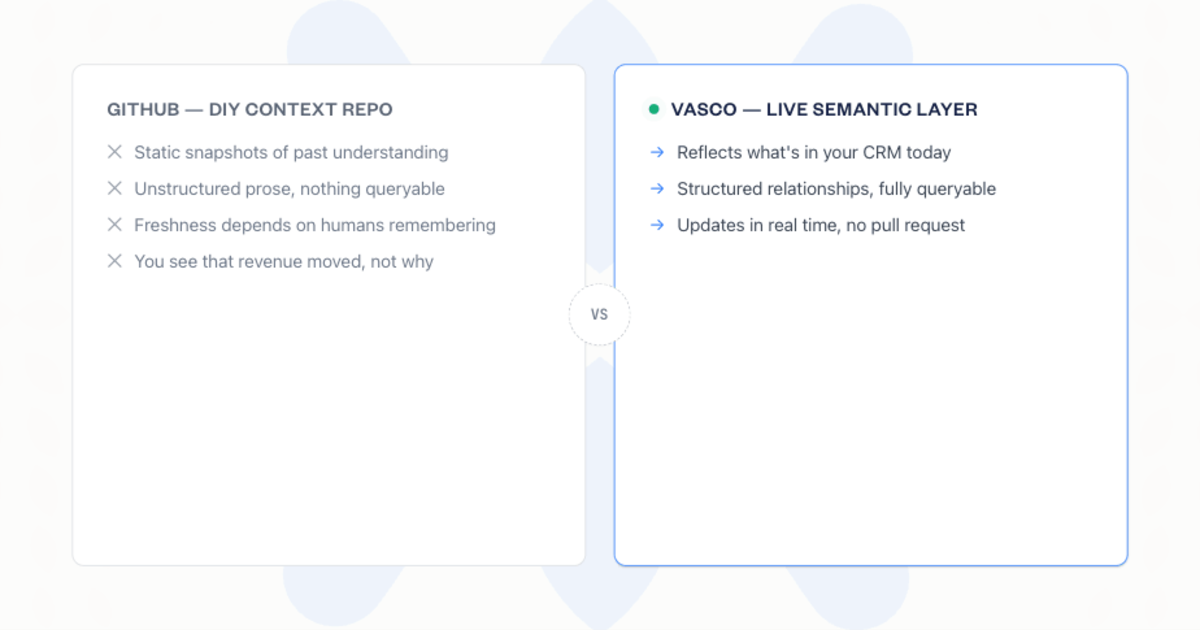
A live semantic data layer does all of that. Instead of storing documents, it builds a structured, queryable representation of your revenue data sitting directly over your stack, updating in real time. Vasco does this for HubSpot, Gong, Stripe, and the rest. The agent isn't interpreting prose. It's querying a live graph of relationships between accounts, contacts, deals, pipeline stages, and revenue events.
GitHub: DIY context repo
- Static snapshots of past understanding
- Unstructured prose, no queryable relationships
- Freshness that depends on humans remembering to update it
- No causal tracing. You see that revenue moved, not why.
Vasco: live semantic layer
- Reflects what's actually in your CRM and pipeline today
- Structured relationships between accounts, contacts, deals, and events
- Causally linked. Trace why revenue moved, not just that it did.
- Clean, semantically mapped data that cuts hallucinated outputs.
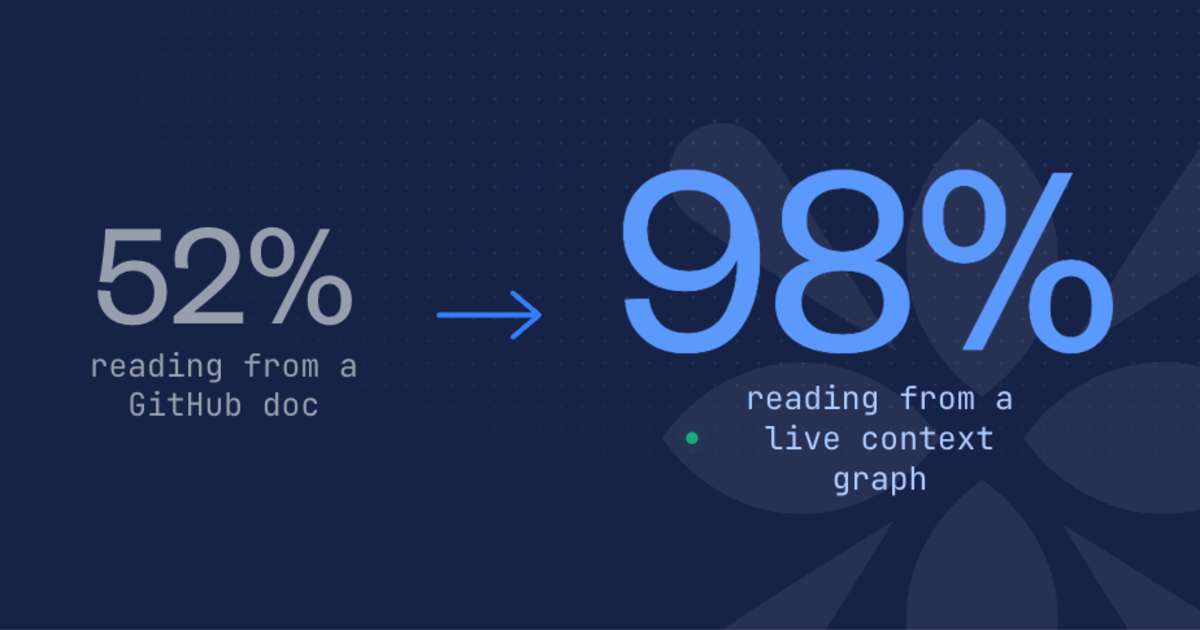
One SaaS company ran the same pipeline review question against a markdown-based context store, then against Vasco's context graph. Accuracy went from 52% to 98%. The model was the same. The context was different.
The four things that make context agent-ready
Four properties separate a layer agents can actually reason from versus one that produces fluent-sounding noise.
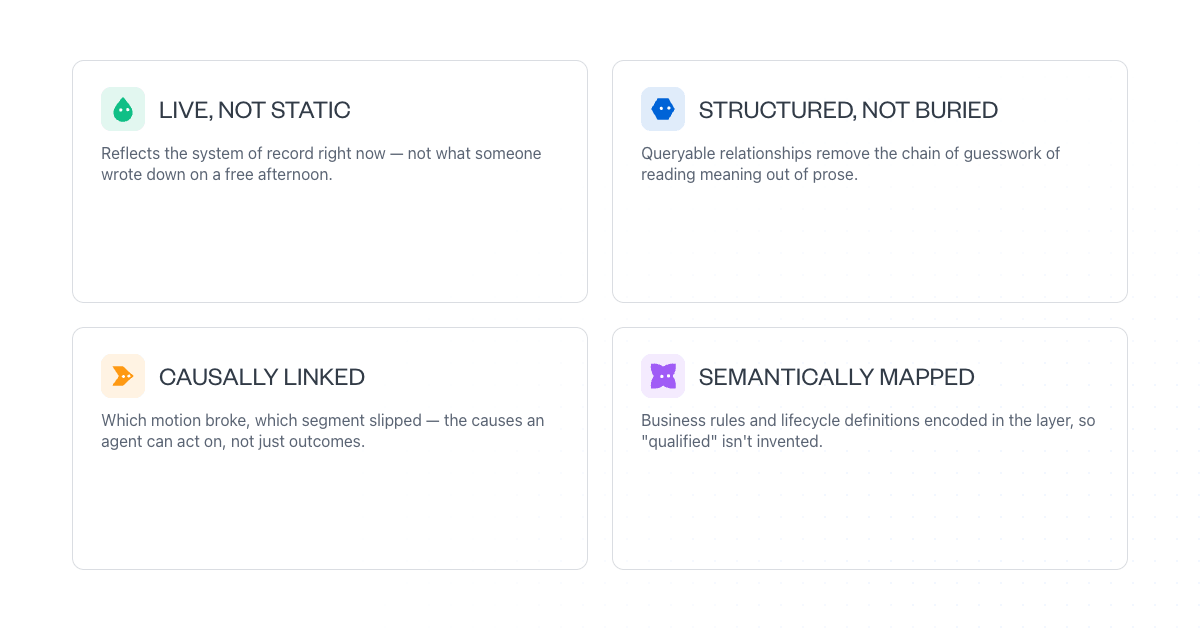
Live, not static
Your ICP from last quarter's planning session isn't the same as the segments closing today. Context has to reflect what's in the system of record right now, not what someone wrote down when they had a free afternoon.
Structured, not buried in prose
When an agent reads through text to understand that Account A is in Enterprise, attached to two open opportunities, with a champion who churned six months ago, it introduces interpretation error at every step. Structured, queryable data removes that chain of guesswork.
Causally linked
Knowing that revenue declined doesn't help anyone act. Knowing which motion broke, which segment slipped, which attribution point went dark: that's what an agent can actually work with. Documents describe outcomes. A semantic layer traces causes.
Semantically mapped
If your agent doesn't know what "qualified opportunity" means in your specific motion, it'll invent a definition. That definition will be wrong. Business rules, lifecycle definitions, and attribution logic need to be encoded in the layer itself, not expected to materialize from reasoning over raw CRM data.
None of this lives in a Git repository.
So where does GitHub actually belong?
GitHub is genuinely good at what it was built for: engineering runbooks, prompt templates, internal docs, onboarding guides. When the domain doesn't change with every closed deal or slipped forecast, static files are fine.
GTM isn't that domain. Pipeline changes constantly. Revenue motion shifts week to week. The ICP that was accurate in January might not describe your best customers today. Any context layer built for AI reasoning in a commercial environment has to track those changes automatically, not wait for a human to open a pull request.
The objection that comes up a lot is: "We have this documented in GitHub, so we're covered." Documentation and a data layer solve different problems. One tells your agent what the business looked like. The other tells it what the business looks like right now. A prototype built on the first can look impressive and demo well. A production agent needs the second.
Tired of second-guessing your AI's pipeline numbers?
Vasco connects to your existing stack, HubSpot, Gong, Stripe, and builds a live context graph your AI agents can reason from accurately. Your current setup stays intact. Run a free diagnostic in minutes and see exactly where your data is breaking before your agents do.
Forecast accuracy went from 52% to 98% for one team. Same model, better foundation.