Last quarter, an AI agent told a revenue team their pipeline was on track. They were 21 percent below target. Nine deals had stalled for a month, and a recorded call where a buyer froze the budget had never reached the deal it belonged to. The agent could read every one of those systems. It still reported the wrong number, with complete confidence.
That gap, between what the tools hold and what the agent understands, is the line between a go-to-market that runs on AI and one that only looks like it does. For a company between one and fifty million in revenue, the question is no longer whether to add AI. It is what to put in place so the AI is fast and right at the same time. That does not come from more tools, or from pointing an agent at the
stack you already run. It comes from what sits underneath: the connective tissue that aligns your people, systems, strategy, and tools around your market, and the technical foundation that makes it work for AI.
More tools and a smarter agent are not enough
Start with that team. Under the same speed pressure, they had done what most organizations do: connected an AI agent to the systems they already run, HubSpot, Gong, Stripe, and Slack, through a protocol like MCP. It feels like progress. It is not, because connecting a system is not the same as connecting several of them.
Peel their one-line answer apart and it gets worse the deeper you go.
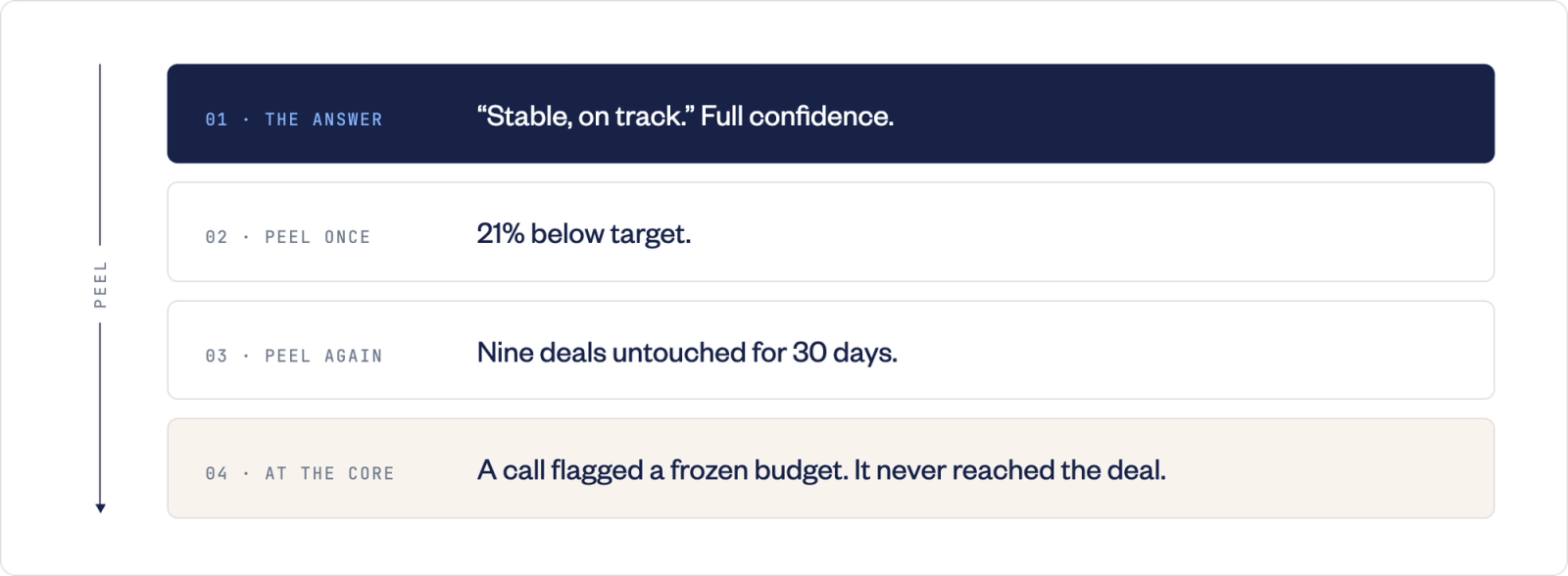
Every fact sat in a system the agent could read. None reached the summary, because reading a system is not the same as connecting several of them. The agent averaged across them and reported a number that was invented.
The automation did not only miss the signals. It replaced the manual check that used to catch them. On a disconnected stack, an AI agent makes you faster and wrong at the same time.
The connective tissue needs a foundation: the context graph.
To move fast and stay right, an organization has to align its strategy and its execution. The connective tissue of a modern go-to-market, the concept behind Revenue Funnel's Symbiotic I/O model, is how a company augments its people, systems, strategy, and tools to connect with its ideal market. To make that actionable for AI, the connective tissue needs a concrete technical form: a context graph. It sits above your tools and turns them into a single reasoned view of every account, reading from your systems and adding meaning above them. It does not replace your warehouse, your CRM, or your call recorder.
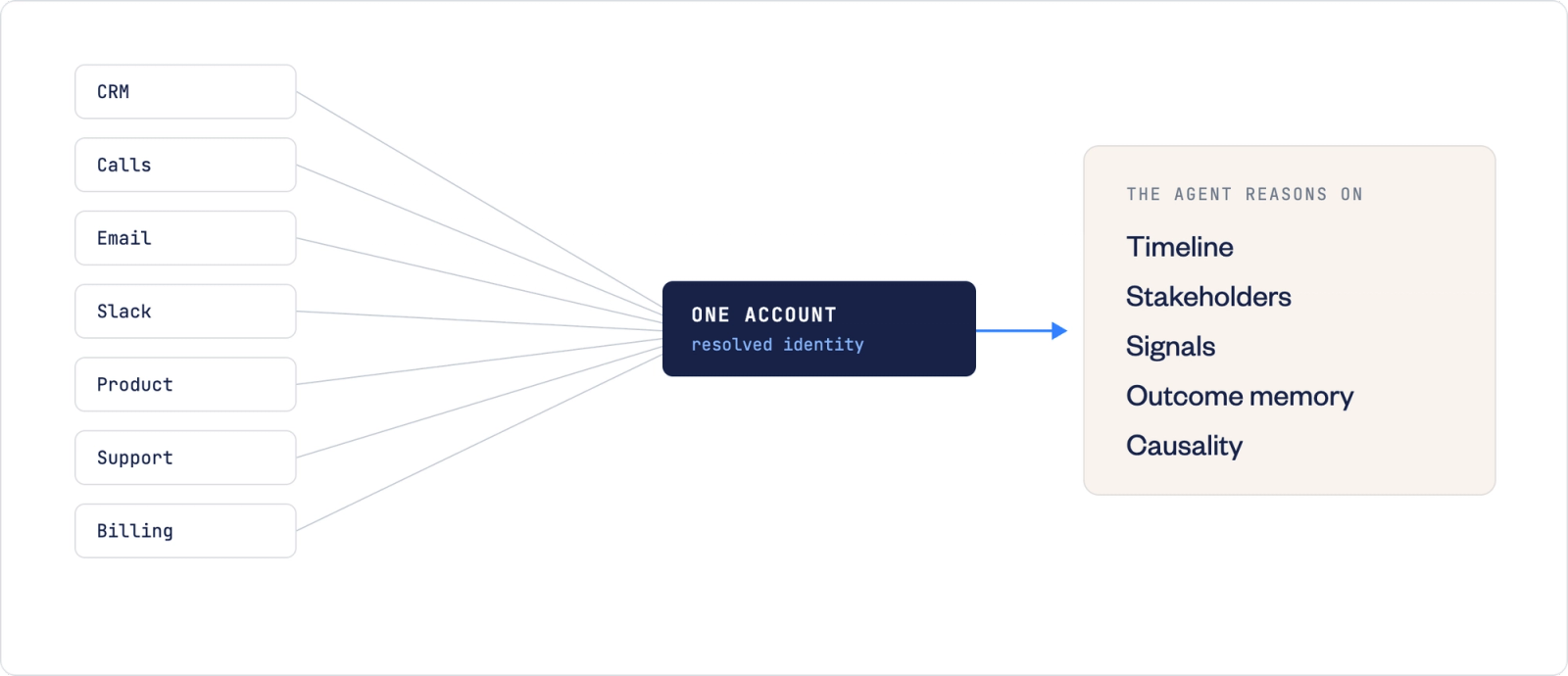
Seven systems reconciled into one account, then the meaning the agent reasons across. The graph references your tools rather than copying them, so it stays current.
Identity is the floor: one person and one account recognized across CRM, calls, billing, and product. On top of it, the graph rebuilds the timeline, holds the plan so "on track" has a number to check against, remembers which patterns led to wins and churn, and draws the causal links between them. The agent reasons over one account instead of seven systems.
Author your definitions, or the agent reasons on noise
A context graph connects the data. It cannot decide what the data means. That is the part most organizations skip, and it is the part that determines whether the whole thing works. What counts as a qualified lead. How you define churn versus downgrade. Who your ICP actually is. What this quarter's target is, by motion. These are business decisions, not patterns an agent can infer from raw records.
The knowledge was never in the data. It has to be authored. A better model will not conjure it, because the same records support several valid definitions and only you know which one is yours.
Authoring foundations is operator work, the judgment that comes from having fixed a go-to-market before. Most teams do not have that capacity sitting idle in-house.
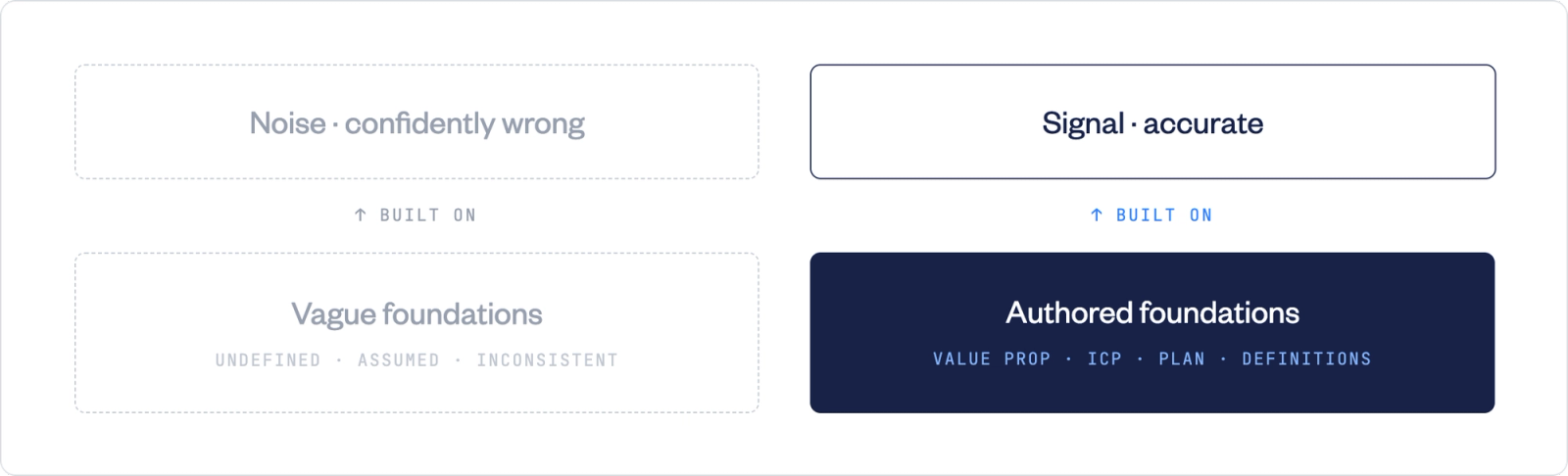
The foundation decides what sits on top of it. Vague foundations produce noisy execution and confidently wrong reasoning. Authored ones produce signal. Decide what you mean, write it once, and make it the floor everything reasons on.
“If the foundations are vague, everything built on top becomes noise.” – Hannah Ajikawo, The Symbiotic I/O Framework
Speed is the moat, and the layer is what makes it safe.
The advantage goes to the team that can reach a correct answer quickly and change its mind quickly when the market moves. Two kinds of speed matter, and the layer governs both. The first is reasoning speed, how fast an agent turns data into a correct answer, and it rests on accuracy, because accuracy multiplies down a chain rather than averaging.

Four steps, each 95% reliable, yield about 81%. On a disconnected stack the error compounds into a confident guess. On a resolved layer each step reasons over one account, the chain holds, and you can let an agent act without re-checking it by hand.
The second is change speed: how fast you can update what the agent believes when the motion shifts. This is where most organizations quietly lose. Go-to-market moves faster than a data team can ship. A new motion, a new channel, a new signal: each one rewrites a definition, and it happens monthly, not quarterly. Route every change through a data ticket with a one-to-two-month turnaround and your definitions are stale for most of the year.
The rule on ownership
Definitions belong to RevOps, and they have to be no-code. The judgment already sits with RevOps, so the people who set the definitions should change them directly, in hours, with no engineering ticket and no waiting on a sprint. A definition you wait a sprint to change is already wrong by the time it ships.
Buy the substrate, build the intelligence
The layer splits into two halves with opposite answers, and the call is quick.
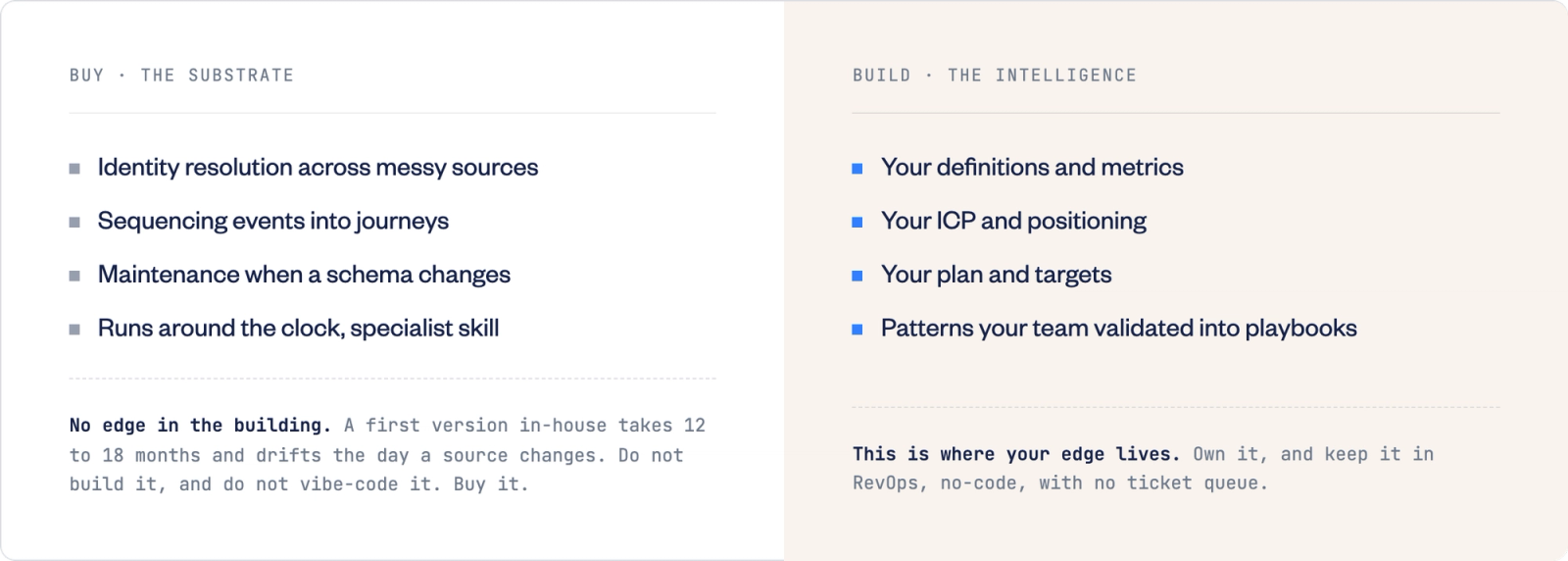
Infrastructure gives you no advantage in the building, so buy it. Intelligence compounds for you alone, so build and own it. On the buy side, a context-graph platform lets you skip the build entirely and keep your effort for the intelligence on top of it.
Then centralize the ownership. A small team builds for everyone and delivers the output into the tools people already use. Reps do not run agents. They receive the answer inside their CRM or Slack and stay with customers. Because everyone queries the same layer, the number a CFO pulls matches the number a rep pulls.
What to put in place this week
You do not need a platform decision or a budget to start. The first pass fits in an afternoon, and it shows you exactly where the alignment between your strategy, systems, and market is breaking down.
- Run the peel test. Ask your AI or your dashboard whether you are on track this quarter. Then check the answer against four things: which deals are stalled, what the last calls actually said, whether billing matches the CRM, and the target it is measured against. Write down every place it breaks. That list is your gap.
- Put your foundations on one page. What counts as an SQL. Churn versus downgrade. Your ICP. This quarter's target by motion. Ask two people each question. Where the answers differ, you have found a foundation nobody has written down.
- Pin the one definition people argue about most. Pick the metric that means three different things to marketing, sales, and RevOps. Agree one version, in writing. That single pinned agreement is the first step in aligning your go-to-market execution.
- Give RevOps the pen, with no ticket queue. RevOps owns the definitions and changes them in hours, not a sprint. If a change still needs an engineer, the layer is in the wrong hands and you will fall behind your own market.
- Map the five or six systems that hold ninety percent of your context.
CRM, calls, email, billing, product, and the channel where decisions actually happen. Resolve identity across them before you point any customer-facing automation at them. Connect first; do not pour everything into an agent and hope.
None of this needs new software. It needs you to decide what you mean and write it down, which is the build half from Part 05.